At Caltrain’s June board meeting, agency staff provided the details about the delays and cost overruns that close watchers had been anticipating. The forecast date of delivery is extended to 2024, and the project budget has grown by over $300 Million.
The sources of delays
The biggest delay is caused by the signaling system used to lower the gates when a train is approaching. Caltrain is in a dispute with the main contractor, Balfour Beatty, and is considering taking that part of the project and handing it to a different vendor.
The next largest delay is caused by the electric train cars. Construction has been slowed by Covid factory shutdowns and the bankruptcy of one of the parts suppliers. The main train supplier, Stadler, has had to take over the production of wall panels and luggage racks. The delivery of the first trains has been delayed until February 2022 and the last trainset is now scheduled for delivery in August, 2023.
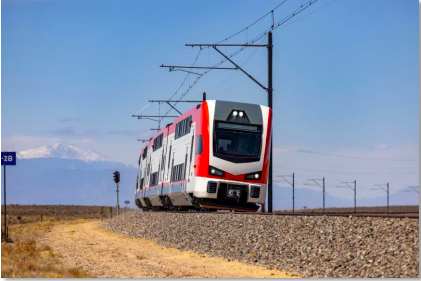
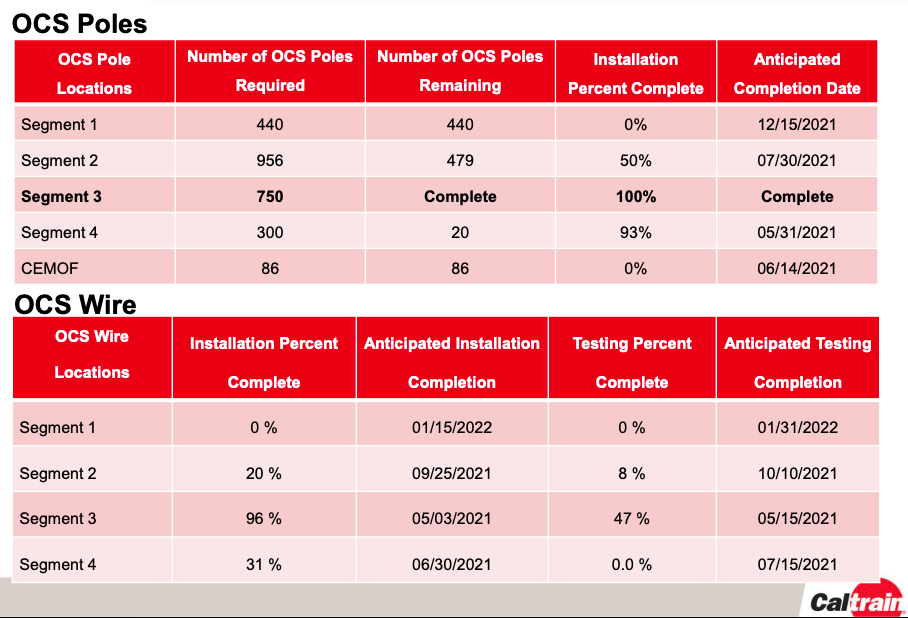
The electric poles and wires are somewhat delayed but are expected to be completed in 2022. After that, Caltrain will continue to run diesel trains for another couple of years under the electric wires.
Cost increases
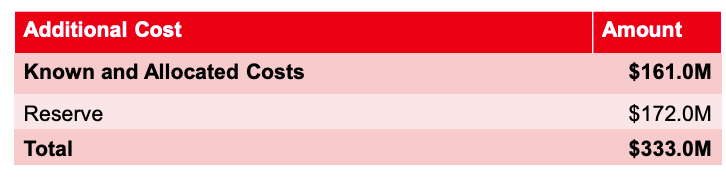
The increase in costs includes $161 million of known cost overruns, and $172 million required to be held in reserve for risks not known yet.
To pay for the cost overrun, Caltrain has secured $52.4 million from the American Rescue Plan, and is seeking additional grant funding. Caltrain plans to issue bonds secured by Measure RR, and to seek additional funding from partner agencies.
Regionalizing megaproject delivery?
Caltrain electrification joins BART-Silicon Valley, the Central Subway, and the Salesforce Transbay Terminal/Downtown Extension in the long history of Bay Area projects that are late and over budget. The Bay Area in particular, and the US in general have a poor track record at managing big capital projects.
Regional think tank SPUR held an informative forum about a year ago on the topic, and has been recommending “the establishment of an “Infrastructure Bay Area” organization to plan, prioritize and approve projects for the whole region” in order to deliver big projects more efficiently and effectively.
As Caltrain discusses regional governance options later this month, the need to effectively manage the major capital program envisioned to deliver the goals of the Caltrain business plan service vision for a high-capacity, well-integrated network will hopefully be considered.


Roland LeBrun, San Jose, said constant warning time (CWT) is a piece of technology that makes it possible to maintain a constant warning time between gates coming down and the actual arrival of the train regardless of the train speed. The problem is CWT has to use small currents in the rails to determine the train position and speed. He said CWT, as it exists today, will no longer work once the tracks are electrified. He asked why there was no CWT functionality in the CBOSS presentation. Mr. LeBrun said he would like staff to provide him with a copy of the CBOSS RFP, including questions and answers from the qualified bidders, and preferably without having to go through a Public Records Request
https://www.caltrain.com/Assets/__Agendas+and+Minutes/JPB/Board+of+Directors/Minutes/2013/6-6-13+JPB+Minutes.pdf.
January 18, 2012
“Invensys Rail has integrated its Coded Audio Track Circuit (PSO 4000) and its GCP 4000 Crossing Controller technologies to provide an Occupancy Detector System that can be configured to provide constant warning time in electrified territory. This means that a coded, audio, overlay track circuit is available for electrified territory in an integrated crossing package—the “Crossing-In-A-Box” for electrified territory. Invensys’ crossing-protection products and systems are equally applicable to transit or heavy rail passenger operation where grade crossings are present.”
https://www.railwayage.com/regulatory/raising-the-bar-on-crossing-protection/
They FINALLY posted the truth about the extent of the catastrophe: https://www.caltrain.com/Assets/Caltrain+Modernization+Program/Documents/PMOC+Reports/December+2020+-+FTA+Risk+Refresh+Report.pdf