As the lockdown response needed to save lives from the pandemic opens deep holes in public sector budgets, the escalated costs of the next phase of the BART Silicon Valley project are looking ever more unattainable and unwise. Two factors are causing costs to climb.
First, an unprecedented tunneling method, proposed to reduce construction disruptions to Downtown San Jose, is technically complicated and costly to build. Second, extending passenger service north of Diridon Station to Santa Clara duplicates Caltrain, providing minimal benefits to riders at enormous added cost.
The VTA board will be holding a study session on Friday, April 17 staring at 9am to consider the BART Phase 2 project – it is time to reconsider tunneling method and route alignment choices to reduce costs and construction risks to ultimately deliver a successful project in a reasonable timeframe.
Last fall, VTA disclosed that Bart Silicon Valley Phase 2, which will extend the line from Berryessa to Downtown San Jose, had been delayed by four years to 2030, and the estimated cost had risen by $800m to $5.6bn (Old Budget; New Budget) These time and cost increases go well beyond the delays and problems with the Silicon Valley BART project’s Phase 1 extension to Berryessa, with opening recently pushed back to June 2020, four years later than the originally promised 2016 opening.
We support the BART Phase 2 extension and celebrate its high-level goals: connecting Downtown San Jose, finally closing the regional rail ring around the Bay with a connection at Diridon station, and supporting infill development.
You can share your thoughts with the VTA board, by calling into the teleconference board workshop starting at 9am and make an audio public comment – see the agenda and links to instructions here. Or send a note to the VTA board secretary, board.secretary@vta.org.
Opportunities to reduce costs
As design for Phase 2 is only two percent complete, we can expect further delay and cost increases as design and construction progress. As the Covid-19 recession deepens financial challenges, decision-makers have the opportunity and the obligation to look at opportunities to prune costs, including.
- Reconsider the decision to require wide bore tunnels to accommodate side-by-side tracks, which has added $800 million to the project cost
- Revisit the twin-bore tunnel option to reduce cost and risk
- Revisit options to reduce the amount of tunneling, including use of cut and cover construction for stations with methods to reduce street disruptions and business impacts
- Review station designs, considering more compact designs without mezzanines to reduce costs and make passenger access faster and easier.
- Eliminate the redundant segment between Diridon and Santa Clara, which parallels Caltrain
- Support initiatives for more coordinated regional transit planning and project delivery, to reduce these sorts of challenges in the future.
Wide-Bore Tunnels
In 2017, VTA and BART announced that they were investigating the use of a single-bore tunnel for Phase 2. While the existing BART system was dug as two small (20ft diameter) tunnels for the two sets of rails with station platforms in between, the wide-bore approach would involve digging one large (45ft diameter) tunnel which could contain both sets of rails and the station platforms within its diameter. Then, in the next iteration of design planning, the tunnel width was proposed to be increased from 45ft to 55ft, to accommodate side-by-side platforms in a single tunnel – using among the largest tunnel boring machines ever built – a choice that we now know has added $800m to the cost of the project.
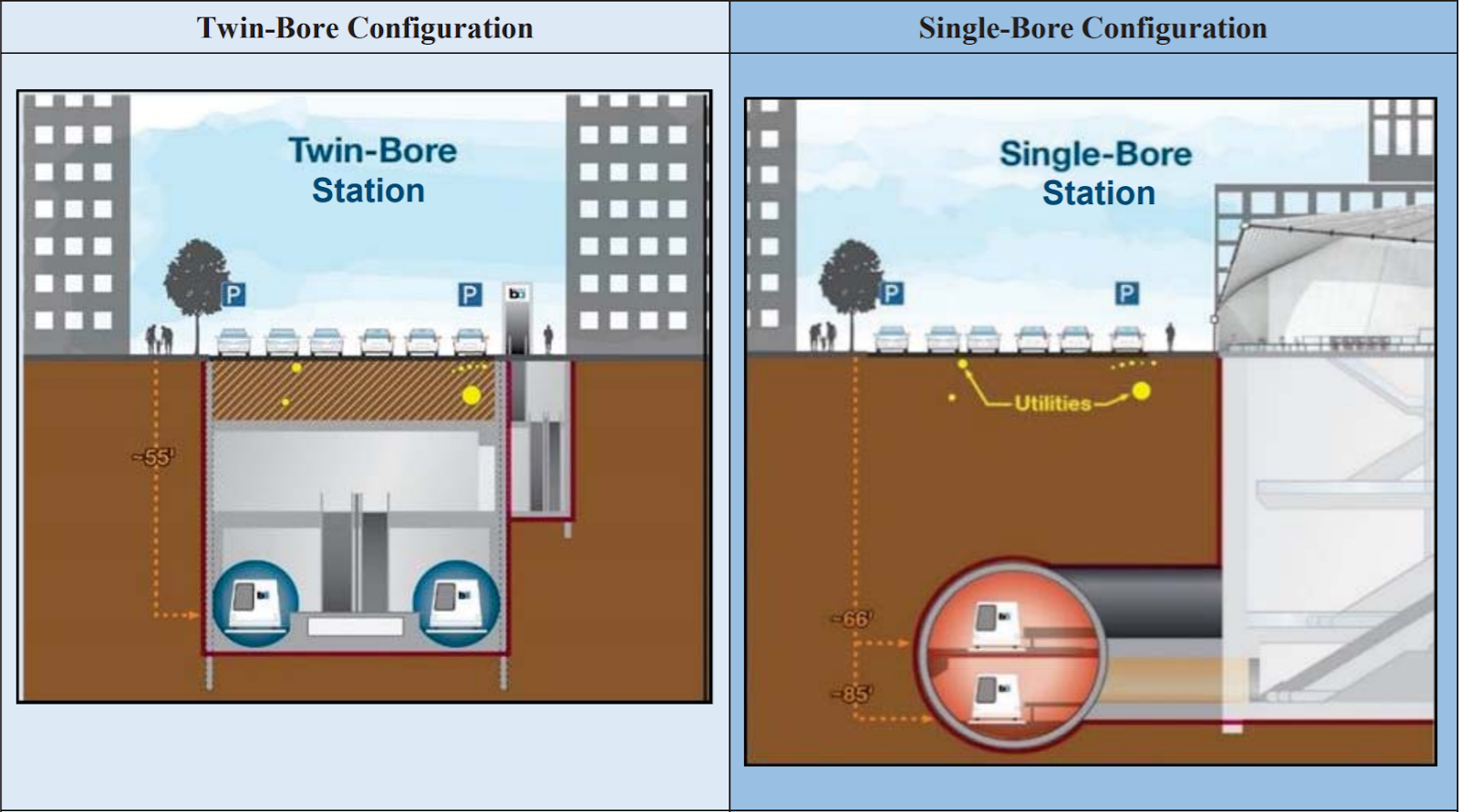
VTA image demonstrating twin-bore vs single-bore tunnels
Single-bore construction has proved effective in some international projects, such as the Barcelona Metro. As the image below shows, in order to fit both sets of rails plus platforms into the tunnel, trains would have to run in a stacked profile (one on top of the other) rather than side by side, as in most of the BART system. While BART mostly uses side-by-side platforms, the downtown SF stations are stacked, with Muni tracks on the upper level and BART on the lower level, and the 12th and 19th street BART stations have two levels. https://en.wikipedia.org/wiki/De_Pijp_metro_station
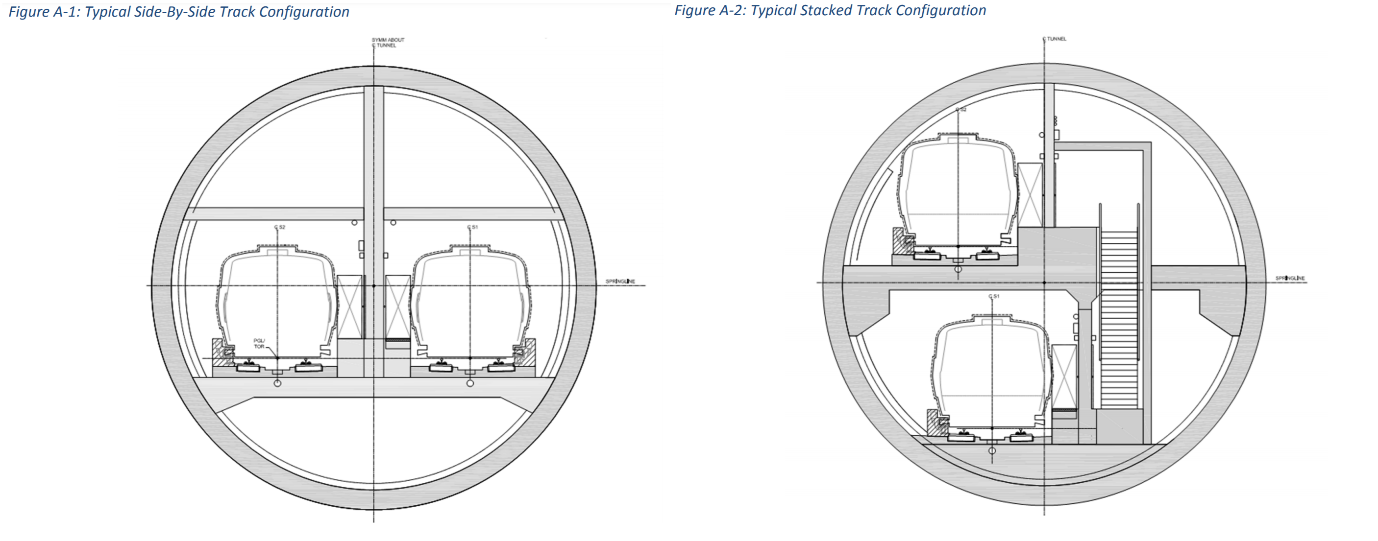
Comparison of side-by-side and stacked track configurations
The stacked profile has been used in other metro systems around the world, such as recently in Amsterdam, with no safety or operational issues. Despite this fact, BART staff expressed concern that the stacked track configuration would not meet its fire safety requirements. In particular, BART expressed the opinion that evacuation procedures might be “unintuitive” for passengers. In order to allay this fear, VTA and BART convened a panel of transit experts from peer agencies such as WMATA, LA Metro, SFMTA, New York’s NYCT and MTA, and MARTA, to review the evidence and provide feedback on the approach. The result of this review was startling: even though the panel found that “the single-bore tunnel can be operated safely as an extension of the BART system”, they recommended that VTA move to side-by-side tracks in order to avoid additional training for train operators and first responders.
As noted above, to accommodate side-by-side platforms with a single bore, the tunnels would need to be widened from 45ft to 55ft, leading to the fall announcement of an $800 million increase in cost and for additional years to deliver the project.
We understand that training for operating staff and wayfinding for passengers for disaster situations is life-saving – especially since disasters are rare, familiar designs and standards are better. But we strongly question whether the reduced need for extra training and design is worth the cost. $800m represents an entire year of BART’s operational budget or about a year and a half of VTA’s local transit operating budget.
Revisit tunnel design and construction methods
Given the budget challenges facing the region with the Covid-19 crisis, it may be worth stepping back further to look again at cheaper tunnelling approaches such as cut-and-cover or the Sequential Excavation Method.
The “sequential excavation” method has been recently used for the Los Angeles Regional Connector project where the tunnel was delivered on time . The Tunnel Technical Studies Report notes that the design aims to “reduce cut-and-cover construction” due to street-level impacts, but thanks to modern advances cut-and-cover can be employed while keeping major roads open, using the Milan Method, in which the decking is installed at the start of construction and excavation occurs below the decking (see image below). This method also has the advantage of bringing stations closer to the surface, reducing costs and making ingress and egress faster and easier for passengers.
In any event, VTA should consult with tunnelling experts from places that have successfully built metro systems at low cost. Countries including Korea, Spain, Italy, and Norway and others have a great deal of experience in this area, and it would be wise to seek guidance from any agencies willing to assist.

Lower Cost Stations
While the Supplemental Environmental Impact Statement Financial chapter provides little detail, based on other projects it is likely that stations are contributing significantly to the high relative cost of Phase 2
As a result, stations above all should be built using cut-and-cover methods wherever possible. Construction is isolated to just the station box area, not the entire tunnel. As an example the Eglinton Crosstown line in central Toronto is building 15 underground stations as cut and cover (with twin bore tunnels), a neighborhood that is denser than downtown San Jose, along narrower, 80 feet right of way compared to Santa Clara Street’s width of 95-100 feet.
Stations should also be limited to the smallest size necessary. Large mezzanines and open spaces are often popular with designers as they can create an impressive effect, but should be avoided as they drive up costs substantially, and can increase time for travelers to access the station platforms, and make stations more difficult to patrol and maintain. Glen Park, Balboa Park, South San Francisco, and San Bruno BART stations are examples of BART stations without mezzanines where the street level functions as the pedestrian circulation area
Eliminate redundant Santa Clara passenger service
Fragmented transit agencies are a cause of another issue with the Phase 2 project: the duplication of Caltrain services between Diridon and Santa Clara station with parallel BART tracks. As the map below shows, a substantial proportion of the tunnel, and one out of four of the stations in Phase 2, are to link Diridon station with Santa Clara. This might be a sensible extension if it weren’t for the fact that there is already a rail service between these points: Caltrain.
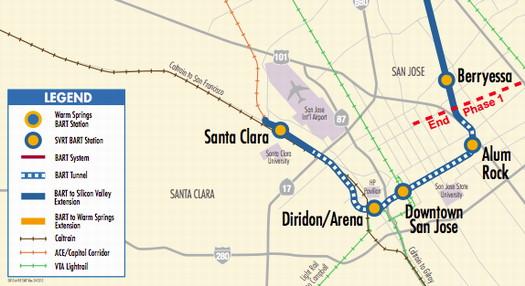
Phase 2 Project Map
Caltrain’s program of electrification, and the Business Plan Service Vision with goals for even greater frequency increases will mean trains running between Diridon and Santa Clara at least every 15 minutes before the BART Phase 2 extension is complete, obviating the need for any duplicate service.
As with fire safety, good operational planning can remove any downsides. Timed transfers could allow passengers to move between BART and Caltrain services quickly and easily, adding only a few minutes to a journey.
The BART-SV Phase 2 project includes a maintenance yard at Newhall in Santa Clara, which has been used as a rationale for building a new station in Santa Clara. If BART continued to use the maintenance yard in Hayward, it would need to back trains up about 25 miles from the end of the line at Diridon. This is not unheard of elsewhere in the world. For example, it is common in the UK to have yards well away from the ends of the line, such as Thameslink which has its southern yard 20 miles from its southern terminus at Brighton. The cost of the deadheading will surely be lower than the cost additional rail segment. Another option could be to revisit an earlier idea to store and maintain trains at the Las Plumas site near the Berryessa station, which would reduce the amount of deadheading to about 4 miles (see page 32 onward, here:https://www.vta.org/sites/default/files/2019-10/Chapter%202%20Alternatives.pdf

In any event, the location of a yard does not justify building a redundant station, staffing the redundant station and running duplicate passenger service. Currently, BART occasionally stops at the Hayward Yard for staff, but but there isn’t a passenger station just because there is a maintenance yard.
Removing this unneeded station would likely save hundreds of millions, and additional millions in operating costs over time – at a time when VTA is having to prune local service because of lack of operating funding.
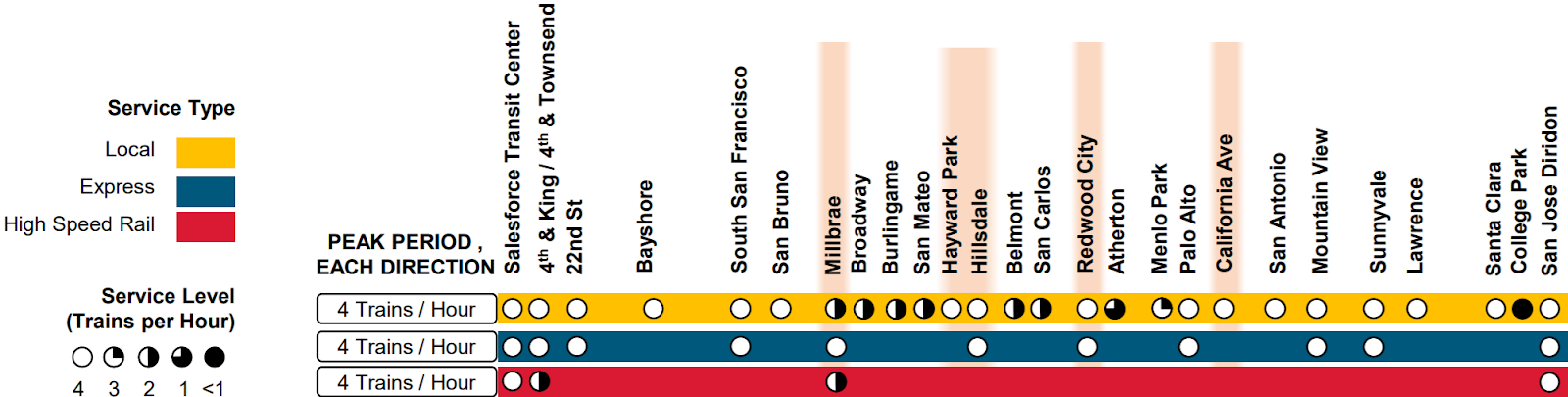
Proposed Caltrain Electrified Service Plan
The original planning for the BART Silicon Valley project was done in the 90s when the Peninsula Corridor Joint Powers Board had recently rescued the commuter rail service from closure and viability was still in doubt. A rationale at the time was that extending BART to Santa Clara would create a good position to further extend BART up the Peninsula Corridor to connect to Millbrae.
This vision remains in Santa Clara Clara County, where VTA recently submitted a project to build BART between Millbrae and Santa Clara, parallel to Caltrain, to MTC’s PlanBayArea – where it scored poorly.
Conditions have changed dramatically since BART SV was funded in 2000. Caltrain ridership skyrocketed, and a $2B electrification project is under way. Even the most recent environmental studies for BART SV were done before Caltrain electrification funding was confirmed. The BART Silicon Valley project should coordinate rather than compete with the upcoming Caltrain service increases , and eliminate the cost of the Santa Clara station, and prioritize a seamless connection with Caltrain at Diridon station.
Reduce Costs, Speed Completion
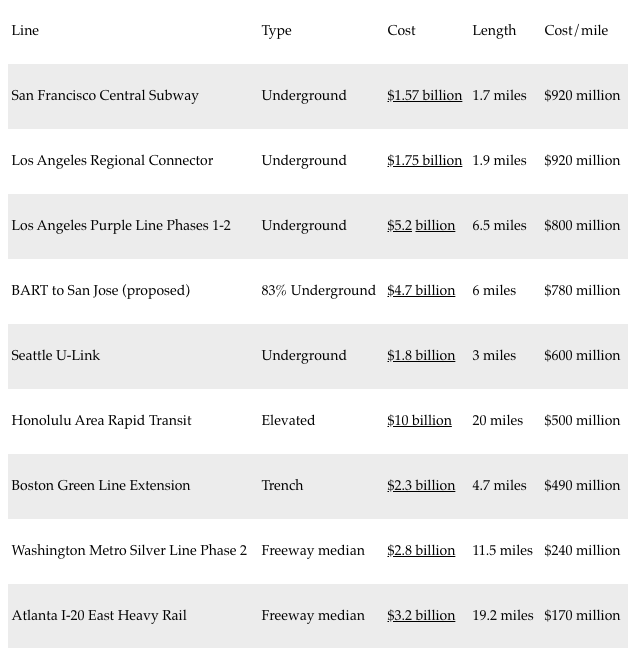
In total, the tunnel section of Phase 2 represents around 4.5 miles, or 7.2km (see sec 5.3.1). At a cost of $5.6bn this represents a price of $1.3B per mile, substantially higher than the LA Regional Connector, LA Purple Line, or San Francisco’s Central Subway.
According to this 2018 Citylab article by transit researcher Alon Levy, “Most subway lines cluster in the range of $200 million to $500 million per mile; in Amsterdam, a six-mile subway line cost 3.1 billion Euros, or about $4 billion, after severe cost overruns, delays, and damage to nearby buildings” (see table image below). Barcelona’s fully automated Line 9 project, from which the single-bore design was taken, was authorized in the same year as the Silicon Valley extension. That project cost ~$300m per mile and opened its entire ~30 mile length in 2016. At that rate, the entire Phase 2 project would come to only $1.3bn, and would have been completed years ago.
For more detail, Levy has conveniently put together a data table with metro costs from around the world. (Note: the cost estimate shown for the BART SV Phase 2 project is before the recent round of increases).
Given that the original sales tax that was supposed to fund BART to Silicon Valley passed in 2000, it will likely be over 30 years in total from initial funding to completion for the 13 mile extension. By contrast, the original 75 mile BART system was completed only 15 years after the establishment of the BART District.
Institutional improvements needed
The high costs and extended construction time for BART-SV Phase 2 aren’t just problems with this project. Similar issues are found in many projects in the Bay Area, where the fragmented nature of our public transportation system, and the need for many individual agencies to do one-off megaprojects, result in expenditures that cost too much, take too long, and may not deliver enough value.
The design choices for this project are affected by fragmented Bay Area governance and divided responsibilities.
- If BART were spending “its own” money, perhaps $800m in savings would be sufficient to incentivise improved training, but here the construction costs will be borne by VTA, while operational issues are BART’s responsibility.
- The Santa Clara service and station come from different budgets than Caltrain’s capital and operating budgets. Instead of seeking to reduce redundancy, VTA is seeking to reduce its operating contribution to Caltrain, while proposing a program to completely duplicate Caltrain service on the Peninsula that it would own and control.
The Bay Area needs an accountable Network Managing agency that plans the network as a network, rather than as individual projects meeting the needs of competing agencies.
- A network manager looking to create a coordinated loop of backbone rail around the Bay would not choose to extend BART from Diridon to Santa Clara, duplicating the Caltrain service.
- A network manager responsible for the Bay Area’s capital program might consider $800 million in capital savings sufficient to incent additional training, and would consider other ways to reduce costs on this project and deliver more transportation benefits per dollar
Some of the problems with Bay Area megaprojects are exacerbated by the situation where individual agencies build one-off megaprojects, and the region never develops the staff and skill needed to build projects on time and on schedule. A single infrastructure developer for the region’s transit agencies would be a good start, to avoid the agency conflicts documented above.
But in an era when money will be tight and transit will need to win back ridership, we can’t afford to continue to repeat the mistakes of past Bay Area capital projects that have gone over budget, overtime, and too often haven’t delivered high quality, multi-modal transit facilities that significantly increase transit ridership .


There are recent VTA documents showing/stating that VTA is planning to start construction at the far (Santa Clara) end of the line … perhaps to lock-in and defend their now-unwise and profligate decades-old decision to have nearly 1/3 of their Phase II SJ BART extension needlessly duplicate and parallel Caltrain to a huge parking garage cum station at the planned Santa Clara station and yard.
Will any VTA board members have the courage to value engineer this project back to something approaching reasonable? Something that responsible planners would design from a clean sheet of paper based on everything that is known today (vs. a couple of decades ago)?
East Santa Clara Street between N14th and N17th streets is being planned by the Santa Clara county for a huge office and residential development: https://www.sccgov.org/sites/faf/capital-projects/escs/Pages/home.aspx
Considering BART Phase 2 will require a ventilation building one block away on N13th street, do you think it is possible for the ventilation building, a rough later-infill station to be built under the the proposed and planned development between N14th and N17th street?
Since the station will need to be dug underground anyway, the 3 story proposed parking structure can be relocated underground on top/adjacent of the subway station, or even not be needed at all with the enormously expanded transit capacity in that area. Without the parking structure above ground, land is saved for the development of higher revenue buildings such as another office or residential tower. Cost saving #1.
Ventilation build will no longer require the appropriation of land specifically for it. Cost saving #2
Construction of the future-infill station allows the area to be used as another staging ground for construction equipment and tunneling start/end points. Potential cost saving #3.
Superlative kudos to Adina for this OUTSTANDING post!!!
Please allow me to add a little bit of flesh to this superb expose on the VTA BART catastrophe:
– “Removing this unneeded station would likely save hundreds of millions” this is correct: FIFTEEN hundred millions to be precise.
– “As design for Phase 2 is only two percent complete”. This is true and the primary reason why HNTB and Parsons Brinckerhoff have spent ONLY $250M on “managing” “design” so far (as of last December).
– ” including use of cut and cover construction for stations”. True and it is unclear why anyone who knows anything about station design would ever have considered anything other than cut & cover at Diridon and Berryessa (Crossrail’s Canary Wharf, Paddington and Woolwich come to mind). Anybody who knows anything about Diridon also knows that the only way to “integrate” the light rail and BART is to bury both inside a cut & cover box (a la Embarcadero) UNDER the Caltrain tracks.
– With regards to the Downtown station, yes, SEM is the only way to avoid a repeat of the 40 years of collateral damage to Market Street in San Francisco. The gory details are here: https://www.vta.org/sites/default/files/documents/VTA%27s%2520BART%2520Ph%2520II%2520Ext-SC%2520Underground%2520Stns.pdf
Short version: https://www.youtube.com/watch?v=aoMF1Hk3Ro0&feature=youtu.be&t=673
VTA presentation:
The only improvement is that Alum Rock is now a cut & cover station.
They also figured out ($250M later) that there was no way a single-bore TBM was ever going to fit under Highway 101 so they start with a twin bore on Las Plumas and switch to a single bore in the middle of a 700-foot trench on East Santa Clara between 12th Street and 16th Street (are you serious???)
There is another one of these 700-foot beauties under Stockton
http://santaclaravta.iqm2.com/Citizens/FileOpen.aspx?Type=4&ID=9516&MeetingID=3331
If that does not get the bloody lot fired, what will???
Build A Shorter Tunnel Extending CalTrain to DTSJ. Construct a intermodal station there, if you wish, to existing VTA light rail segments serving the communities of SJ and the proposed phase 2 stations in DTSJ to CalTrain instead of BART.
Since SJ has CalTrain, why is VTA even bothering with BART and wasting money acceding to their standards and demands when monies can be reallocated for SJ only infrastructure? Why not capitalize on CalTrain assets, and why all the focus on the perception of a cure-all BART?
BART is practical serving the communities near SF. The ride alone from Diridon to the Market St. stations would make commuting via BART a real chore, time consuming, and pricy fare-wise. The line is already impacted from Fremont, and now Warm Springs, due to too many local stops through east bay stations to SF. SJ commuters can utilize a less stressed, peninsular trip.
You have a much more pleasant and comfortable CalTrain locomotive and an established, direct link through the peninsula directly to SF with no bottlenecking. CalTrain is investing and undergoing capital improvements for their riders. The money pouring into BART could have been used to procure more CalTrains, and eliminating the at-grade crossings on its ROW. So move on and focus locally on SJ by severing all ties to BART. Build more light rail lines with a partnership with Caltrain in Santa Clara instead of mindlessly crossing over the event horizon into the artificial singularity of BART.
Move forward by utilizing fundings to extend CalTrain further into SJ (since they are electrifying) or extend VTA light rail to an intermodal SJ station. A CalTrain and/or VTA light rail tunnel, if necessary, would be a local matter with local input to its design. And the infrastructure is adapted to existing VTA and CalTrain specifications not BART’s resulting in a practical and cheaper alternative and option as a local consensus. There were reasons why BART was not extended on CalTrain’s ROW and Santa Clara county declining to join BART.
BART specifications and budgeting to that effect only compounded the problem for VTA & SJ. There is now an inferior standard complicating public transit in SJ. It should have never been extended from Fremont. The line was already a bit too long to its former terminus. Not extending CalTrain or VTA light rail was a squandered and cheaper opportunity. SJ chose a lesser quality of life standard with BART instead of focusing on a SJ/CalTrain/VTA vision.
BART is too big and it shows when they add trackage to their system. The SFO extension led to intra-agency dispute with BART and SamTrans. If there were truly a demand to commute to SFO, CalTrain and/or SFO could have constructed a cheaper people mover (similar to the line between the BART Coliseum station to Oakland Int’l Airport) into a CalTrain station. It was a colossal waste of taxpayer money to extend BART from Daly City further down the peninsula when CalTrain had already had a presence. There was a rationale on why the San Mateo supervisors declined to assimilate to the BART district: local interests. SamTrans relinquishing control of BART in their county to BART proper only vindicated San Mateo’s county’s decision from refraining to join BART decades ago and sends a message to Santa Clara.
And already BART and VTA is disagreeing over practical designs due to “safety” with the latter capitulating while the second phase is still a glimmer and not guaranteed. Take the hint, nip it in the bud, and cut your losses. The new stations were excessively delayed and over-designed in commencing revenue service, over budgeted, and too immersed with BART minutiae to cater to antiquated practices and to an obsolete, 70’s technology where the agency have to find parts on eBay which BART admits.
They even admit its too expensive to extend their system. They compromised with diesel multiple units at the Pittsburg/Bay Point station to Antioch. So those riders have to inconveniently transfer there. And BART refused an extension from Dublin/Pleasanton to Livermore (or beyond into the central valley). And due to cost, it will forever preclude any extension into Marin county which the constituencies there do not want there anyways due to local interests.
Extending BART will further complicate schedules on all their lines due to the bottlenecking of their only transbay tube. All this nonsense talk about a second transbay tube is a pipe dream. Why should SJ even bend over backwards with that added complication and nonsense to their commute times when CalTrain directly links to SF? And with BART upgrading their infrastructure on their older segments (while BART chooses to do so on their terms) which the extension from SJ will connect to traverse, it will make the trip that much longer to an already overextended line. Furthermore, ridership is declining on BART mainly because of increased crime and no BART police presence. The channel 4 investigations should be a factor in not inheriting those problems into SJ. If BART police is spread thin as it is, then SJ commuters will suffer even more with the magical promises of BART.
BART had nothing to lose because the VTA is footing the bill to extend their system since Santa Clara county is not part of the BART district. How convenient. And then VTA will pay BART to operate revenue service into VTA trackage and stations it built for BART. Wow! BART couldn’t have it better!
Now, if that agreement included the BART district solely and completely funding an added third track from Fremont to the downtown Oakland stations creating an express train/line and constructing a second transbay tube, the convenience of BART from/to SJ would make a whole lot of more sense and equitable for SJ commuters.
Finally, a coordinated transportation system in the Bay Area with the hundreds of different agencies will never work for one reason: each agency and their departments operate fragmented with all these fiefdoms and conflicting agendas from within and intra-agency wide. This bureaucratic maze and in-fighting is a waste of time and energy to push against that inertia that will never budge. It is here to stay and is never going away. Ironically and worse, unifying all these agencies as one will also result in the same outcome heeding true that the more things change, the more it will stay the same.
Realistically, breaking down the problems to a local level where it is manageable to minimize the local inconveniences to local needs is practical because the problem of inconvenience is not going away while trying to think big or small. There will still be deficiencies and inefficiency no matter what. Who will SJ compromise well with others? CalTrain and the peninsular cities or deal with BART and the sole transbay tube? Which is a better, higher standard for SJ?
More extraordinary developments during last Thursday’s “Coffee with Takis Salpeas”:
First of all, the explanation for the “rationale” behind the switching between single bore and twin bore @13th Street is “to increase competitiveness” when the real reason is that the single bore TBM cannot possibly go under Coyote Creek, let alone Highway 101 even after they rip out millions of dollars of recently laid Berryessa tail tracks to accommodate the longer single bore portal (Takis mentioned 450 feet).
Next, Scott Knies (Downtown Association) asked how they could possibly have station entrances on the south side of Santa Clara when the stacked platforms are facing the north side. Takis promised Scott that he would “have an engineering solution in 100 days”.
The World is (literally) dying to learn more…
Teresa Alvarado (SPUR) had a superb idea: how about starting out with a Minimum Operating Segment (MOS) between Berryessa and 13th Street to start BART service at 28th Street while we wait for the completion of the Downtown shenanigans?
Takis’ response was that he did not have environmental clearance to do this, conveniently ignoring the fact he does not have environmental clearance (let alone funding) for two $500M 750-foot- long and 90-foot-deep cut & cover boxes complete with centerboard platforms “to be used only in an emergency”.
Theresa’s concept is the perfect segway for the ultimate solution given the following facts:
1) A Diridon “Integrated” Station cannot possibly be achieved without a cut & cover BART+light rail box (a la Embarcadero) with an at-grade concourse under the elevated Caltrain tracks.
2) The distance between the 28th Street and Diridon cut & cover station boxes is the same as the distance between the proposed (new) cut & cover “emergency” stations at 13th Street and Stockton so the same objective could be achieved without any additional environmental impacts at a saving of $1B by eliminating the two redundant “emergency station” boxes.
3) Having a separate Diridon to Santa Clara extension would FINALLY reveal the TRUE cost of this extension (approximately $1.5B)
4) The combined savings for 3) and 4) above would result in a total saving of $2.5B or more than enough for elevating the tracks at Diridon, grade-separating Auzerais and a new 3-track bridge over Highway 280.