With budget challenges looming in the 3-year window before electric service starts, the Caltrain board discussed funding options at a board workshop on December 14, including the â…› cent sales tax option approved by the legislature in 2017, and the potential to once again increase fares. Â Â Options to address the funding gap raise important consequences for governance, equity, and climate.
An â…› cent sales tax would raise $94 million per year to provide stable funding for operations and maintenance. Â While riders have been paying over 70% of the annual operating budget in fares, the bulk of the remaining public funding comes from the three county partners.
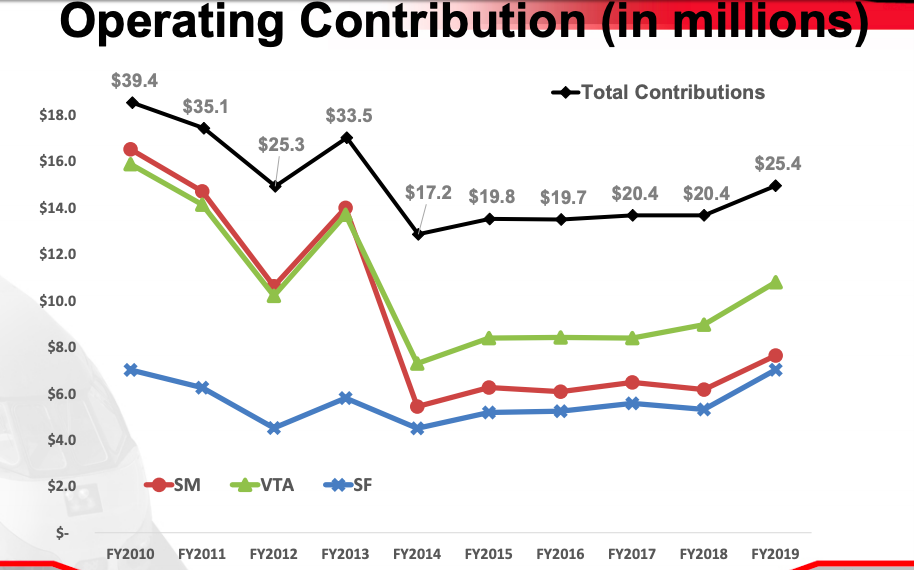
The contribution of Joint Powers Board members included 25.8 million in operating funding (17% of the total) and 22.6 million in ordinary capital spending (keeping trains in good repair, station upkeep, etc, not counting electrification construction). Â Operating expenses are expected to increase, with greater payments to train operating staff, including to run the positive train control system, and greater fuel costs before electric service starts.

Fare increase, and equity questions
The board members discussed the possibility of a fare increase to help close the budget gap before electrification. Caltrain’s rider base has a very high income, and Caltrain’s fare study suggests that increasing fares will not lose many riders. But Caltrain’s relatively high fares and high income rider population become a self-perpetuating feedback loop. Low and moderate income riders are priced out, and increasing fares prices the service even further out of reach.
Currently, Caltrain’s deepest discounts go to its high income riders with the GoPass, which is available only to full-time employees of large corporations, and is not available to large numbers of contractors who work for outsourcing vendors at the sites of major corporations. Nor is it available to employees covered by Transportation Management Associations that manage transportation benefits for smaller companies.
Caltrain is increasing the price of the GoPass by 20% this month (January 2019), but that still leaves GoPass riders paying less per trip than other customers. Â To raise revenue and improve equity, Caltrain could likely increase the GoPass price further. And especially, Caltrain could extend the GoPass to cover outsourcing contractors and workers whose benefits are managed by Transportation Management Associations.
Ballot measure, partner pullout, and governance implications
Partners – VTA in particular, which is facing serious budget challenges, are talking about taking advantage of the sales tax to reduce or eliminate funding for Caltrain.
From minutes of the December 14 special board meeting, “Director Chavez expressed concern regarding VTA’s ability to invest in Caltrain in the future and stated the current funding asks should be reformatted with a “must have/nice to have†approach.”
If the ballot measure is used to *replace* the contributions of the current county partners, that may raises questions for voters. Â And it raises bigger strategic questions about how Caltrain will and should be governed in the age of electrification.
Questions about voter value and governance implications
If the funding partners pull out when the ballot measure passes, that would leave less than half of the new funding for improved customer service and capital improvements that voters would notice.
We’re wondering if this strategy would raise concerns for voters, who might expect that new Caltrain taxes would be devoted to notable improvements to service and congestion relief, rather than being devoted to helping VTA, SamTrans, and SF with other budget needs.  Voters are going to need a compelling vision of how this ballot measure – as part of bigger strategy – will improve service, alleviate congestion, fight climate change.
And if funding partners decide to pull out, that also raises larger governance questions regarding how Caltrain should be structured and who should be in charge of setting direction for the service. Â Â When the Peninsula Corridor Joint Powers Board took responsibility for running Peninsula Corridor service in 1992 from the State of California, board logically consisted of representatives of the three county agencies that contributed most of the annual public funding: the City and County of San Francisco, the San Mateo County Transit District (SamTrans), and the Santa Clara Valley Transportation Authority (VTA).
Governance and strategy for great service
Caltrain’s business plan process, and the big transition to electric service, is already a logical opportunity for fresh thinking about how Caltrain should be governed.  To think about this touchy subject, it is helpful to consider the strategic questions – what are the medium and longterm goas, and what governance structure will help it reach those goals?
Integrated service.  One of Caltrain’s goals in the business plan is providing regionally integrated service.  This need will become even greater in the future, when BART is extended to San Jose Diridon station, when the Downtown Extension connects the Caltrain tracks to downtown SF.  Even more regional and megaregional integration will be needed when/if Dumbarton Rail service brings passengers to and from the East Bay and Central Valley.
Fundraising to increase ridership.   As readers will know, Caltrain’s ridership analysis for the business plan concludes that Caltrain could increase ridership by nearly 4x, to ~250,000 riders, by increasing service and improving infrastructure.  Global examples suggest that increasing service might result in even stronger financial performance than Caltrain’s 70% farebox recovery. Infrastructure improvements will be needed to increase ridership, including longer trains, level boarding, and station improvements. The funding from the SB797 ballot measure is a good first step but additional funding will be needed for those investments.
There are several logical options that would address the needs.
- Make Caltrain a special district.  The complicated multi-agency process needed to put a sales tax on the ballot highlights the fact that unlike BART, Caltrain doesn’t have the powers of a special district that can raise funding.  State legislation could create a special district allowing the agency to raise funding in the future. With less contribution from county partners, it would make logical sense for the board composition to change. Since 70% of revenues come from riders, it might make sense to have board representation from major employers that contribute many riders; and perhaps from other groups representing riders.  The latter option would be similar to the SFMTA board, which has had representatives from transit/livable streets/active transportation advocacy groups appointed. Since Caltrain is an increasingly important corridor for the state, it might be relevant to have a State representative.
- Combine Caltrain with BART. Â In the 1960s, Santa Clara County and San Mateo County decided not to join the BART district; Santa Clara because they wanted to focus on the County Expressway system, and San Mateo County because local leaders feared connections to ethnically diverse parts of the bay. These historically unfortunate decisions could be repaired by extending the BART district to San Mateo and Santa Clara Counties, adding board representation for the new counties. Â A combined agency could treat the services as a single service, with an integrated schedule and single fare system.
- Combine with other regional rail services. ACE and Capitol Corridor both use standard gauge tracks and have more technically in common with Caltrain.  However, these services have much lower ridership, so combination might help less to provide funding and seamless customer experiences.
- Establish a Bay Area “transport federation†that could require integrated fares and schedules around the region. This has the potential to significantly improve transit user experience in the Bay Area. However, the change would be at a larger scale and outside of Caltrain’s control.
Caltrain strategy, funding and climate
A recent report from the California Air Resources Board concluded that even if electric vehicle market share increased tenfold by 2030,  California needs to reduce driving miles by 25% to reach the state’s Climate Goals. And a recent United Nations Climate Report indicated that the planet has a dozen years to cut greenhouse gas emissions to prevent severe consequences of global warming.
Caltrain’s board needs to be prudent about its budget in the next few years before electric service starts and before a ballot measure providing dedicated funding. That said, the improvements to Caltrain service and infrastructure that would remove a couple of hundred thousand cars of the highways seems like a “must have†rather than a “nice to have.â€
What do you think?
Should Caltrain strengthen its governance to be able to grow to meet pent up demand and climate goals? Â Which of the sets of choices would do the best job to help reach the goals?
In the age of electrification, how should we think about fares? Â Should Caltrain – as part of the region – work toward moderately priced integrated fares that do the best job of competing with driving and taking hundreds of thousands cars off the road? Â Should Caltrain position itself as a luxury niche product, for a select set of customers?
Share your thoughts in comments, and to Caltrain at businessplan@caltrain.com. Feel free to copy adina.levin@friendsofcaltrain.com


I see that directly electing the Caltrain Board of Directors members with district elections like the BART and AC Transit boards do is not among your proposed options for governance changes. Why not?
Especially the idea that corporations should have their own representatives on the Caltrain Board is offensive and foolish. Corporations already control the agency’s agenda and major decisions via corruption. It would be even more counterproductive to institutionalize that corruption by giving corporations their own seat on the Board of Directors.
If corporations are for making commuter’s life better, then they share the same interest and see no reason why they can’t be on the board.
I really think we need a Regional Measure that forces regional fares on all agencies that receive tax dollars. You could hire a math intern to come up with a revenue neutral plan over course of a summer, and this will never happen unless the difficult decision is made by the people.
Martin and anybody else interested in this good idea – check out and sign up at https://www.seamlessbayarea.org/ to be updated on proposals for mandatory regional fare and schedule integration backed and conditioned by funding.
The challenge with directly elected board members for obscure special districts is that incumbents tend to stay in office for decades at a time. It doesn’t necessarily get the level of additional responsiveness and accountability that you’d think you’d get from elected boards.
Caltrain really needs to take control over it’s funding – it’s horrible how the 3 counties jerk Caltrain around when one county decides they don’t want to pay their full share. Caltrain funding either needs to be fixed (not alterable) by the counties, or they need their own separate funding source. Train maintenance is becoming a bigger and bigger issue the closer we get to the new electric trains. Trains are breaking down frequently – especially the bombardiers.
Thanks for the link to seamlessbayarea.org. I’m glad to see an organized effort to push this – I’ve been asking Caltrain, VTA and BART officials for years about this.
While I’m not opposed to corporations to sit on a board, I surely don’t want them to exert more power than the commuter representative.
I think that Caltrain should raise fares as long as the trains are at full capacity. That clearly indicates that they are providing a service that is competitive with driving in terms of price and convenience. Go Passes should also cost more if the peak hour trains are full.
Equity should be addressed by subsidies to those riders that need it rather than lowering the fare for everyone — including those who are willing and able to pay full fare. Keeping an artificially low fare will result in a death spiral as service has to be cut to balance the budget, which then results in less revenue, and so on.
The extra revenue from higher fares can be used to avoid a regressive sales tax increase and/or to leave more money to SamTrans and VTA, who are likely to use it to support bus service. The money can also be used to increase train service levels, which will then lead to more fare revenue in a virtuous cycle.
I think the primary goal should be to get as many people as possible out of cars and into trains.
I don’t agree that fares should rise. They need to stay competitive with other forms and you’ll be scaring off new riders who are more likely to do the math than existing riders.
@Matthew Self Artificially Increasing fares can also result in a death spiral and it defeats your primary goal of getting as many people out of cars and on to trains as possible. Caltrain ridership has dropped in recent months, perhaps due to fare increase, crowded trains and lower gas prices. Trains are crowded due to Caltrain’s failure to increase capacity. Yes, increasing capacity costs money, but not increasing capacity could cost Caltrain even more. Caltrain has increased capacity somewhat but more is needed.
The cost of Go-Pass is burdened by employers, who must purchase Go-Pass for all eligible employees, even if they don’t ride Caltrain, so if 25 out of 200 employees use Caltrain, the employer must purchase 200 Go-Passes. Employees are not required to pay for their Go-Pass, which are generally provided as an employee benefit. Other employee benefit programs allow employers to provide compensation to cover the cost of transit tickets/passes. Herein lies an analytical problem with understanding the true elasticity of Caltrain customers. Caltrain has determined that ridership is “inelastic†and therefore can increase fares without significant ridership loss. Has Caltrain done any meaningful analysis of employer subsidies effects on customers choices to use Caltrain? What if Go-Pass customers were required to pay the full monthly pass fare? What if all employer subsides were to disappear, forcing riders to pay full fare to ride Caltrain? I have not seen anything in the fare study or business plan that addresses this issue.
Low-income equity may be solved by so-called means-based subsidies but how do we address moderate income equities? The posting by Adina raises a good point regarding this issue.
Unfortunately, Caltrain staff is probably insensitive to fare increases they propose for board adoption. Staff is among the high-income riders and their Caltrain commute is covered by Go-Passes provided by their employer (SamTrans). It is really annoying to hear staff say that Caltrain fares are a great bargain and monthly passes are too “deeply discounted†whatever that is supposed to mean? Or the standpoint that our riders have relatively high income and can afford artificially high fares.