The Bay Area, and California as a whole, have a deep housing shortage dating back 40 years. More than a third of young adults live with a parent, leading to a mass exodus. The housing challenge is a transportation challenge – commute times have increased 17% over the past decade, adding an average of 43 minutes weekly per commuter.  And the transportation challenge is an environmental challenge – transportation is the largest source of greenhouse gas emissions in California, and we’ve been falling behind on transportation emissions.
This legislative season, California State Senator Scott Wiener launched a bill that’s getting national attention, seeking to take these challenges head-on by removing barriers to adding homes near transit. SB827 is up for hearing in the Senate Transportation and Housing Committee on April 17.
A bill more modest in scope, sponsored by Assembly Members David Chiu and Tim Grayson proposes to set minimal zoning standards, for land owned by BART around BART stations. The BART TOD bill is up for hearing in the Assembly Local Government committee on April 18 (was April 11).
What are your thoughts about these proposals?
 BART transit-oriented development – AB2923 (Chiu, Grayson)
Recently, Millbrae City Council approved two transit-oriented developments adding homes, jobs and stores to the area next to Millbrae BART/Caltrain. Â One of the two developments is on land owned by BART, that had been used for surface parking.
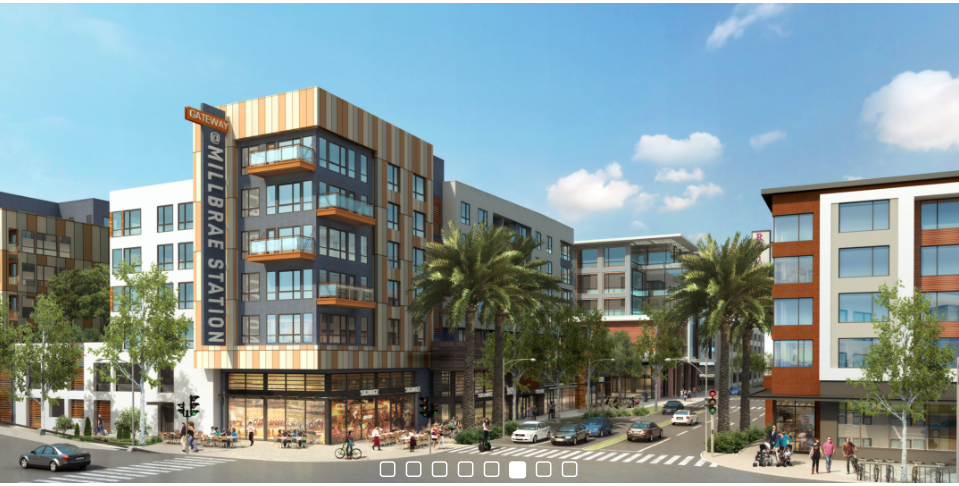
BART has a transit-oriented development policy with a goal of using land it owns around stations to produce more than 20,000 new units of housing, of which 7,000 will be below-market-rate, along with 4.5million square feet of office and commercial space.  The City of Millbrae created a plan for transit-oriented development at the Millbrae station nearly 20 years ago. But it has taken until now for the plans to be completed and developments to be approved.
These scenarios are not unusual. Bill supporters report that a development at Ashby BART was created to serve disability organizations, featuring two floors of housing. The housing was removed; the development was required to have enough parking for a regular office building; and the parking remains 70% unoccupied. The development took 13 years to navigate the approval process.  A development on BART land in San Leandro similarly took 11 years, and had its affordable housing scaled back.
The bill, AB2923, would make this sort of development near BART stations less difficult, by requiring local zoning for BART-owned land to be consistent with standards established in BART’s transit-oriented development policies, and by streamlining the approval of those developments.
The bill requires the BART board to set zoning standards for mixed-use housing on BART-owned land within a half mile of an existing or planned BART station in areas represented on the BART Board (currently Alameda, Contra Costa, and San Francisco Counties).  Then, cities would be required to update their local zoning to be compatible with BART’s TOD zoning. Residential mixed-use projects on BART land following these zoning standards would be be required to provide at least 20% of residential units be offered for low and moderate income residents, and the project would require administrative approval (in other words, they would not need additional local city council approval).
The BART TOD policy uses a typology of “place types”, setting heights and parking standards depending on whether the station is in a regional center, urban neighborhood, or town center.

Caltrain does not yet have a Transit-Oriented Development policy, but is considering creating such a policy in the context of its overall business plan – which could make similar legislation feasible for land Caltrain owns near stations, too.
The BART TOD bill is co-sponsored by Non-Profit Housing Association of Northern California (NPH), and is supported by groups including TransForm, SPUR, Greenbelt Alliance.
The BART TOD bill is up for hearing in the Assembly Local Government Committee on Wednesday April 11.
SB-827: Transit-rich housing around the state
More ambitious, and better known, Scott Wiener’s SB-827 proposes to allow housing for more people by legalizing mid-rise housing within walking distance of rail and “missing middle” housing near frequent bus service around the state.  In the words of recent comments from groups including Natural Resources Defense Council, Environment California, and TransForm (before the bill was scaled back on April 9), SB 827 represents the scale of action necessary to meaningfully address the affordable housing and environmental crises.
SB827 would create a “transit-rich housing bonus†by overriding some aspects of local zoning within a short distance of transit.
Around rail and ferry stations, buildings up to 55’ tall are permitted in the first quarter-mile with and 45’ in the second quarter-mile.
There is no building height increase within a quarter-mile of qualifying bus lines, but density restrictions will be relaxed, and parking requirement limited to .5 spaces per unit; these rules would legalize “missing middle” housing types such as townhouses, triplexes, and quads, where smaller units could fit into a modestly-sized building, providing greater affordability than larger single-family homes because of the smaller footprint.
To qualify, bus service would need to be fairly frequent at peak period (15 minute service) and during the weekday (20 minute average service intervals offpeak between 6am-10pm), and on weekends, qualifying bus stops must also have average service intervals of 30 minutes from 8am-10pm. The top bus corridors in San Mateo / Santa Clara counties, such as ECR and 22/522 qualify for these conditions, but many places provide denser zoning than “missing middle” already.
The bill shifts the obligation that jurisdictions have traditionally put on development to support access, from private automobiles to transit. The latest version of the bill removes parking mandates in the first quarter-mile from rail, and allows a .5 parking spot requirement in the second quarter mile from rail or the first quarter-mile from frequent bus service. Instead of higher parking mandates, a developer using the transit-rich housing program must provide recurring monthly transit passes to all residents at no cost.
Unlike environmental groups NRDC and Environment California, which support the bill’s encouragement of homes near transit, the Sierra Club has opposed the bill, among other things expressing expressing concern that the zoning would discourage cities from welcoming new transit.
On the other hand, though, does it make sense for the state to invest hundreds of millions or billions of dollars in transit capital investments, for places that are not supportive of land use that will generate strong transit ridership?
Another concern raised is that small changes in bus routes could trigger changes in zoning.  Oakland Mayor Libby Schaaf recently recommended that the bill only cover bus rapid transit routes with fixed infrastructure. The scope of the bill was substantially lessened by removing allowable height increases for bus service; would it make sense to add back height for bus rapid transit lines implemented with capital investments making those routes less likely to shift?Â
Displacement and risk to transit ridership
Groups including a coalition of Los Angeles housing and transit groups have expressed concerns that upzoning near transit could result in displacement of current low-income residents. Some studies have been showing that the displacement of low-income residents in areas near transit has been contributing to a decline in transit ridership. Â
To address concerns about direct displacement, the bill has been amended to ban demolition of any rent-controlled housing units, or any units that had an “Ellis Act” eviction (where the owner has a legal justification) in the last five years. Â
Another anti-displacement measure, new in the latest amendments, is a “no net loss” provision. If a developer seeks to use SB 827 to build on a site with rent-controlled or subsidized affordable housing, the developer must replace all such units with a permanently affordable housing unit.
The bill also provides a “right to remain.†If a tenant is displaced because their building is demolished to add more housing under SB827, the developer must house the tenant nearby at the same rent while the project is being built and must provide a comparable unit to the tenant at the same rent once the project is done.
The bill has also been strengthened with the intent to create more below-market rate housing. It respects the “inclusionary zoning†provisions that are in place in many cities, requiring housing developments to include a percentage of below market rate housing. San Francisco Planning Department’s analysis concludes that by legalizing more housing, the result would be substantially more affordable housing in the city.
And the latest version mandates the inclusion of below market rate housing units, for developments with ten or more units. The affordability requirements are summarized in Senator Wiener’s Medium blog post describing the April 9 amendments to the bill.
Groups including TransForm encouraged the bill to require affordable housing, however, the affect of these provisions could vary statewide, since places differ in the amount of affordable housing that market rate developments can be required to include, without suppressing the production of desired housing.
The overall affect of easing land use restrictions near transit could be a major increase in economic opportunity, according to a group of national fair housing experts, who recently commented that overriding exclusionary local land use policies areas of economic opportunity could have a major effect in addressing segregated land use.
Reduced local lontrol
Both the BART TOD bill, and the more famous and larger-scale SB-827 from Scott Wiener, represent a shift from longstanding traditions of local control of zoning in California.
Local government leaders, including Mountain View’s Mayor Lenny Siegel who have been proactive in supporting car-light housing, make a case that persuasion and carrots such as funding for transit improvements, would be more effective at helping the region and state dig out from the housing crisis.
However, a recent report from the state’s department of Housing and Community Development shows that 97% of cities in the state are behind in producing housing to fulfill their Regional Housing Needs Allocation. When 97% of cities aren’t keeping up, there is a strong argument to be made that the local control status quo is failing.
What do you think?
These bills are sparking a lot of discussion about the connections between transit and housing. What do you think. Are these bills…
- Common sense provisions to legalize denser housing near transit where it will have the best results for traffic and climate?
- Good directions, but in need of improvement? (if so, how?)
- Unnecessary – the housing situation is not dire, so major change is not needed?
- Unnecessary – mass transit is becoming obsolete, and autonomous vehicles will soon revive low-density housing and reduce the value of higher-density housing near transit
- Good, bad, or in need of improvement for other reasons?
Share your thoughts in comments…


I attended a panel discussion hosted by Bay Area Forward (thank you) on SB-827. I knew little going in and I came out convinced that this bill subscribes to the chaos theory of public policy. The intended consequences will seem to address San Francisco, where the panel speaker focused on correcting the east vs west density dichotomy, and seems wholly unconcerned with taking the rest of the peninsula down with it. As the good Mayor of Mountain View pointed out, every constituency is valuable, and should have a voice. If an area is to densify then a salient case needs to be made to residents as to how it will be a net benefit for them, and what the corresponding infrastructure (transportation, schools, etc) will be. This albeit messy process serves our communities. Conversely this bill strikes me as a well-intended but misguided way mandate something that the supporters aren’t accomplishing through capable advocacy
Wow! These bills sound exactly like the Yimby funded speech I’d expect of Scott Weiner’s office. Yes, more people are coming to the Bay area. Yes, they’re causing a housing crisis. Instead of working on the base assumption that we must house them, why not institute a 33% local income tax on all income above $250k? Push back on the housing demand. Without pushing back on demand, my fear is that we’ll lose the character of the neighborhoods I now live in and adore.
My neighborhood fits perfectly the bus-profile for ‘higher density’ housing defined above. We already average 0.5 cars per person, so baiting us with better transit funding for higher density housing misses the point on just about every level. The medium to low-income residents of my neighborhood already have places to live. While there are several properties that could be converted to high-rise buildings, would having a large influx of Yimbys help our existing neighborhood? In a word no.
The statements above belie the real issues. More people are moving here. Existing residents are being forced out. New residents are commuting privately in spite of available transit, thereby raising traffic congestion. Towns hosting tech centers, (hello Apple in Cupertino), aren’t funding new housing.
Instead of accommodating population growth, I think it’s time to ask why we started this in the first place. Is anything we’re doing helping existing residents of the Bay Area? Sure, we’re creating jobs, but for who? I think it’s time to push back, and force new more affluent residents to pay for the privilege.
I think these are both great bills. We desperately need more housing in the Bay Area, and putting it near transit is logically a great place for it.
SamTrans has seen declining ridership recently and a lot of new parking-light apartments along ECR could be just the ticket to reverse those trends.
Increasing density near CalTrain and Bart stations is a good idea. However, it’s the people already living in the affected areas that should vote. The rest of us that are not affected should not.
Upzoning from SB827 is good, but not enough. We need an ambitious public housing program too to really ensure that everyone can have a place to live.
@Hamilton? Why not we institute a 33% local income tax on anyone that votes against housing which in turn raises the collective housing for everyone here? Geez, seriously, that’s your idea?
We approve giant office towers next to Hwy 101 which rarely make the back page of news, but trying to put a small tower near transit results in smaller buildings with larger than necessary parking lots. Apartments next to downtown mountain view were heavily downsized, as an example, but apartments next to 237 in Sunnyvale never made the news.
The point of SB-827 is to produce more and higher housing near transit AND to prevent new construction AWAY from transit. If you’re against that, your either proposing sprawl or just a classic NIMBY which is defined as “a person who objects to the siting of something perceived as unpleasant in their own neighborhood, especially while raising no such objections to similar developments elsewhere.”
@Martin, I think we’re working under different sets of premises since you’re restatement of my idea is not the idea I intended to communicate. I’ll try to more clearly describe what my premises are, and then restate my proposed solution.
My assumption is that the Bay area tech boom is causing the housing crisis by increasing the number of people moving here for jobs. If that’s not the case, then admittedly, the rest of what follows is moot.
Working with the tech boom assumption, it seems to me there are two generic solutions to the housing crisis: build more housing, or slow/stop tech boom growth.
Building more housing is the less acceptable of the two solutions for me. It seems arrogant and presumptive to tell a community that already existed their neighborhood should be redesigned because another community wants to move in. Solutions like setting aside a block of new dwellings for lower income, or guaranteeing similar housing nearby for someone that already has a residence sounds a lot like colonization. In short, working under my assumption for the cause of the housing crisis, I’d be far more sympathetic to yimbys if they supported building new housing in backyards they actually owned or had ever lived in.
I’d rather solve the housing crisis by stemming what I perceive as the root cause. If we make it less attractive to move here that will reduce the demand for new housing. I”m also assuming that tech workers are moving here not only for the amenities the area has to offer, but also for financial gain. I’d like to curb their urge to move here. I’d rather not do away with the amenities we already enjoy here, so that leaves financial gain.
The point of the income tax I proposed is to make it much less attractive to move here for financial gains. If I’ve misgauged the income of a new-resident tech worker, then the numbers can be adjusted, but the point is to make it unattractive for the next company that wants to build a massive office tower headquarters in the area.
My proposed solution sidesteps considerations of parking lot or tower sizes by hopefully reducing or eliminating the need for new housing. I’m not a nimby in the sense that I propose the new housing be placed elsewhere. I propose that we reduce the need for new housing to exist at all.
[…] seen in the news. Meanwhile, the more modest AB-2923 which requires cities to make their zoning compatible with BART’s Transit Oriented Development guidelines, passed its first committee hearing, and now heads to the Assembly Natural Resources Committee on […]