The Altamont Commuter Express, ACE for short, connects a growing number of mega-commuters from homes in Stockton and Tracy in the Central Valley to jobs the Bay Area.  “Between 1990 and 2013, the number of people commuting from the northern San Joaquin Valley to the Bay Area more than doubled, growing from 32,000 to nearly 65,000 commutersâ€, according Bay Area Council research.
Driven by the growth of megaregion commuting, “within the last 5 years, ACE ridership has roughly doubled,†according to the Environmental Impact Report for ACEforward, a major program of service and station improvements. The report notes that with the expansions contemplated in the plan, ridership would more than double, increasing 140% to 160% depending on the changes.
In considering ACE’s plans, it is helpful to consider scale.  Today, ACE carries nearly 3,000 commuters (6,000 boardings) per weekday. ACE’s ridership is about 10% the scale of Caltrain, and less than 2% the scale of BART.  (Similarly, Capitol Corridor serves about 4,000 average daily trips.)
The ACEforward study includes a number of concepts to improve connections between ACE and Bay Area regional transit.  “ACE is evaluating the potential establishment of a train-to-train ACE/BART connection in the Tri-Valley and/or Union City to promote intercity transit connectivity between the San Joaquin Valley and portions of the Bay Area ACE does not currently reach, such as San Francisco, the San Francisco Peninsula, and the East Bay. “
This blog post focuses on opportunities to improve connections for ACE commuters to Bay Area jobs concentrated in San Francisco, the Peninsula and South Bay..Currently, the only direct connections are to Caltrain, VTA buses and shuttles at the Santa Clara and San Jose Diridon stations, with a direct light rail connection at Diridon. Better connections would help commuters reach more jobs in San Francisco and Silicon Valley.
The map below shows multiple options to connect megaregion commuters to San Francisco and Peninsula/South Bay jobs.
The ACEforward program includes many more proposed service and station improvements, providing increased service frequency, reliability, and improved travel time “by increasing rail capacity at pinch points along the corridor through the addition of new main tracks, sidings, and possibly a tunnel in the Altamont Hills.†  The plan includes a potential new stop in Downtown Tracy, and extensions to Ceres and to Merced with a connection to High Speed Rail. Readers interested in these broader aspects of the program should check out the ACEforward site here. August 31 is the comment deadline for the ACEforward environmental impact report.

San Francisco connection and the Livermore dilemma
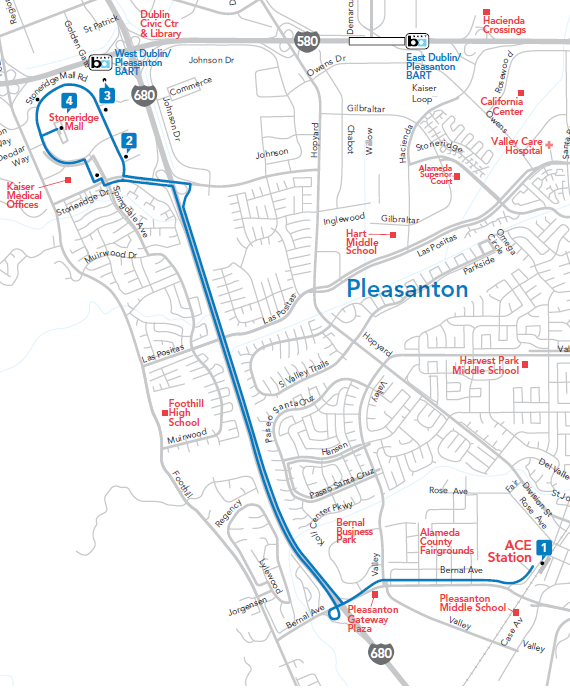
Currently, ACE passengers can connect to BART via a 13-minute bus connection. Wheels Route 53 makes a 13-minute connection between the ACE Pleasanton station to West Dublin/Pleasanton BART. Some access improvements could reduce the transfer time even further (see this Twitter thread)
A logical place for ACE riders to have a direct transfer to BART heading toward Oakland and San Francisco would be Livermore, where there is already an ACE station downtown and further out at Vasco Road.
Unfortunately, the city of Livermore has rejected the concept of extending BART to downtown Livermore. The city’s own studies show that the existing Downtown and Vasco Road stations would be superior locations for transit-oriented development (TOD).

However, local opponents objected to changes that would add denser development downtown.  According to a petition circulated in 2011 by residents advocating against a downtown station location, also linked in the city staff report, “Livermore residents have long desired to maintain our small-town character….this Downtown alignment requires significant amounts of dense urban development and substantial parking in Downtown Livermore, thereby changing the City’s small-town character.”Â
Livermore leaders have instead insisted on an alignment that would keep a Livermore station on the outskirts of town in the center median of the I-580 freeway at Isabel Avenue, accompanied by a 3,412-space parking structure.
Unfortunately, the BART-Livermore Freeway project performs very poorly from the perspective of transportation cost-benefit. The BART-Livermore freeway project would cost $1.3 billion for only 13,400 riders per day, not counting the cost of building an additional extension to an additional Greenville Road station and building another Livermore ACE station there.
Transit analyst Alon Levy notes that at $100,000 per weekday user, the proposed BART Livermore extension would be about four times as expensive as New York’s Second Avenue Subway Phase 1, which is perhaps the most expensive subway project ever (though also delivering high value, serving 176,000 daily riders, well over 10x the ridership of BART Livermore). The proposed BART Livermore project would be about ten times as expensive as ongoing Paris Metro extensions. Levy notes that “light rail lines built in the United States nowadays seem to cluster around $40,000 per weekday rider.â€
Along with the low capital price-performance, the freeway BART extensions would impose ongoing operating costs to the low-ridership stations. 
According to the ACEforward EIR, adding a Livermore connection would account for 14 percent of the total weekday ACE ridership, in 2025 (according to our calculations, that would add about 1,300 daily ACE trips). Â This is a steep cost for an overall project that is getting robust criticism for the poor value that it delivers for the money.
Connections to Mid-Peninsula and South Bay jobs via BART and Dumbarton
There are currently only minimal transit connections from ACE/Capitol Corridor to major Peninsula employers in Palo Alto, Menlo Park and Redwood City.  The only connection is at the Fremont Centerville station to AC Transit’s U bus route which links Fremont BART with Stanford University, Hospital and Shopping Center via the Dumbarton Bridge.Â

Fremont Centerville connections
Several ideas to add ACE connections to Peninsula jobs can be found in the new SamTrans Dumbarton proposal. One idea is to connect to the Fremont Centerville station which serves ACE and Capitol Corridor, near where Fremont Boulevard (Highway 84) crosses the tracks. This is a low-density, under-utilized area with Fremont Blvd as a major bus corridor. Â
Fremont has longstanding plans to redevelop and revitalize Centerville which are hampered by the shortage of transportation options. However, connecting a future Dumbarton rail service to Centerville station would require negotiating a track access agreement with the notoriously challenging Union Pacific to traverse their tracks. UP’s Centerville Line is congested, in part because it is now the only way they can access their line through Niles Canyon. Also, there are complicated track junctions at each end of its short length.
A Dumbarton rail connection would make Centerville a more attractive location for transit-oriented housing and jobs. However, a Centerville connection would not access BART – a shuttle bus to Fremont BART would be needed for riders with destinations between Fremont and Diridon.
Union City connections
Another proposal is to extend the Dumbarton rail service beyond Centerville to meet BART at Union City. The SamTrans study states that “To reach a Union City terminus, Dumbarton Corridor trains would need a new connection between the Niles Subdivision east of the Fremont/Centerville Station and the Oakland Subdivision running north to Union City.†(4-10)
The SamTrans Dumbarton study considers “extending Dumbarton rail service southeast on the Oakland Subdivision into the City of Fremont [from Union City BART], using a new rail bridge over Alameda Creek and a new wye connecting track at Shinn to allow southbound trains on the Oakland Subdivision to head westbound on the UP’s Niles Subdivision (also referred to as the “Centerville Lineâ€). Modifications to the existing Niles Subdivision (Centerville Line)/BART grade separation are required to provide space for the new wye connection. The rail alignment would continue to the existing Fremont Centerville Station for connections with Capitol Corridor and ACE.â€
This proposal would do an excellent job of connecting the proposed Dumbarton rail service to BART at a location where some TOD has already been built, and more is planned, and there are already plans to extend the station to the nearby tracks serving Capitol Corridor. Connecting Dumbarton to Union City does not, however, solve the problem of connecting ACE to BART. Â
Currently ACE trains heading for the Central Valley diverge East from tracks shared with Capitol Corridor after the Centerville station. Â To connect ACE passengers to Union City would require a low productivity spur service, or a new rail shuttle between Centerville and Union City.
A Shinn transfer-only station
Another Fremont proposal is a transfer-only station at Shinn, at a location where BART crosses the heavy rail line not far from the BART Fremont station. This location is a single family neighborhood, with limited opportunities for transit-oriented development.
From a transportation perspective, a Shinn transfer station would provide access to the Tesla plant and perhaps to additional future jobs at the future BART stations. It would have the benefit of connecting to more frequent BART service, but the long-distance trains will still be relatively infrequent, so outbound passengers will often face longer waits.
However, the ACEforward study eliminated the Shinn alternative (UC-C) because BART does not support it. “This alternative was dismissed because it is outside the purpose of ACEforward to change the BART system. BART has no plans to build a station at Shinn due to the close proximity of the Fremont Station.” (Section 6.3.1.2 on page 6-13).
Better connections at Great America Station
Currently, the Great America station in Santa Clara handles about 75% of ACE’s Silicon Valley passengers.  But the “Great America†station in Santa Clara is not so great. It is an lengthy  walk from low-density auto-oriented convention and office uses, and is a 10 minute walk from the VTA Light Rail station that confusingly has the same name.  Most  use one of VTA’s many ACE shuttle bus routes  to reach their jobs in an area of sprawling office parks.
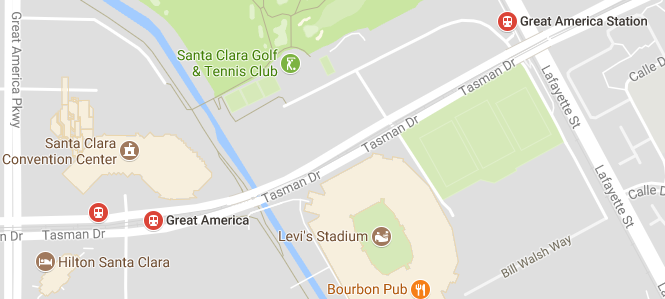
However, near the stations, City of Santa Clara has approved the largest development ever in Santa Clara County, “Related CityPlaceâ€, which will largely be used for office and entertainment, with 9 million square feet on land that is currently a golf course and was formerly a landfill. Nearby Santa Clara is also planning residential uses.
The City is working with VTA on a Multi-Modal Improvement Plan that could include major improvements to the stations, potentially consolidating heavy and light rail, improving bus/shuttle, pedestrian and bicycle access as well. Â However, there are no Great America station and station area improvements included in the EIR or plans. There should be.
Summary
Megaregion commuting is growing rapidly, and it will helpful to increase transit options with better connections to Bay Area jobs. There are a variety of proposals, each with strengths and weaknesses in providing valuable and cost-effective transit connections, and supporting infill transit-oriented development that will serve even more local users than long-distance commuters.
ACE/Megaregion Bay Area Connections
| New and improved connections | TOD potential | Requirements | Challenges | |
| Travelling toward San Francisco… | ||||
| Livermore – Downtown | ACE, BART | Good | Extend BART to downtown Livermore | Local objections to infill development |
| Livermore – 580 Median | ACE, BART | Worse | Extend BART to two new stations at Isabel and Greenville Roads with new ACE station at Greenville Road | Poor cost-effectiveness of rail extensions, lower TOD potential |
| Travelling toward Peninsula/South Bay | ||||
| Union City | Capitol Corridor, BART, Dumbarton | Good | Extend Dumbarton to Union City, expand Union City station with access to adjacent Capitol Corridor/Amtrak tracks. | Challenging access for Dumbarton to UP tracks, ACE connection would need shuttle or backtrack |
| Shinn | ACE, BART, Dumbarton | Minimal | Add transfer-only station where BART crosses ACE tracks, extend Dumbarton | Minimal TOD opportunity, lack of BART support |
| Fremont – Centerville | ACE, Dumbarton | Good | Extend Dumbarton to Centerville | Lack of BART and CC connection |
| Fremont BART (new concept) | ACE, Capitol Corridor, Dumbarton, BART | Good | New conventional rail corridor roughly around Mowry Ave, over-designed for current use | New concept, requires new rail |
| Great America | ACE, Capitol Corridor, VTA light rail, shuttles | Extensive | Consolidate heavy and light rail stations, improve bus/shuttle connections | Current modest Santa Clara support for transit improvements at major TOD location |
Thanks to Adrian Brandt, Randolph Ruiz, Jarrett Mullen, Steven Dunbar and Ellen Teapot for contributing to this blog post, and to Adrian Brandt for the map.
Send me a note to adina.levin@friendsofcaltrain.com if you are interested in more discussion and helping to provide public feedback on these projects providing important regional transit connections.


Was any thought given to running ACE trains on the Dumbarton bridge? This could be a one-seat ride from Stockton to downtown San Francisco.
I think that SamTrans is open to partnerships with other agencies, public or private, to run service on the corridor (but I haven’t read that section of the report yet).
Also note that Capitol Corridor is contemplating on moving its operation to the Mulford Line that’s closer to the Bay. If ACE wanted to create a connecting station to BART it might need to bear the majority of the cost.
Shinn is so obvious that it does not need a “TOD opportunity” or “BART support” (who wants another Milpitas disaster???)
I would say that the most promising connection between BART and ACE would be a BART extension to an Isabel/Stanley station, following I-580 to El Charro Rd. This was considered and rejected in the 2010 EIR due to low ridership, low TOD potential, and impacts to water/mineral resources; but given that the current proposal is a freeway median station at Isabel/I-580 with lower ridership and zero TOD potential, I would like to see the option reconsidered.
This option wouldn’t impact the precious small-town feel of Livermore downtown; it could be a park-and-ride station, like the proposed Isabel/I-580, but with an ACE connection and a quick bus link to downtown on Stanley Blvd. And, if Livermore ever came to their senses about downtown TOD in the future, it would be an easy to extend BART a little further to a downtown station.
A eBART-style DMU shuttle to Greenville in the freeway median sounds attractive on the surface, but doesn’t really pencil out. The alternative is somewhat sandbagged in the BART EIR by assuming two-tracks (and therefore double the freeway widening impacts) whereas initial studies floated a single track with passing sections. However, the EIR also claims that a single track DMU line would result in modest cost savings compared to double track ($78mm, or 6%), and that double track would cost almost exactly the same as conventional BART. Taking the EIR it’s word, a DMU to Greenville is probably not a viable solution.
Routing ACE down the freeway median to BART, as proposed in the ACEforward EIR, is simply a bad idea. Branching divides frequency, and frequency is already so bad for ACE that we should be really careful about reducing it any further; and reversing ACE trains and backing the out of the extension, as was also proposed, is an even worse idea due to added trip time for all passengers not bound for BART. For the same reason, I’m not a fan of an ACE connection to Union City BART; that would work better as a terminus for more frequent Dumbarton trains running to/from SF.
A Shinn transfer station also looks great on the surface, but access to that location is really limited, and any new BART station deserves to be located somewhere with good access and TOD potential. Otherwise you’re adding time to every single BART trip just for the sake of people transferring to the few mainline trains that serve the station each day.
Aside from an Isabel/Stanley station, a longer term option for ACE/BART connectivity would be to re-align ACE between Sunol and Newark by following a new alignment alongside I-680, followed by a new alignment along the water pipeline route from approx. Mission Blvd & Cadencia St in Fremont to the wye at Sycamore St in Newark. ACE could have a joint station with BART at Paseo Padre Pkwy, and could continue over the Dumbarton Bridge to the Peninsula and SF. However, there would likely be major NIMBY opposition to this route, and it would be a challenge to accommodate rail and water pipelines in the same ROW.
Thanks for an excellent article. I agree that Dumbarton rail terminating at Union City BART is an excellent idea. However, ACE is a completely difference story.
ACE/BART connections are driven by SF/Oakland destinations (ACE/VTA connections can better serve Santa Clara County destinations), so a connection in Pleasanton or Livermore makes the most sense. Why crawl through Niles Canyon on ACE to make a connection at Shinn/Union city? It makes no sense to me.
My preference would be the the express BRT Livermore BART option connecting via dedicated on-ramps to the express lanes at a new Greenville Road ACE station. It’s the most cost-effective and direct option and leverages the existing investment in express lanes.
it seems to me like the connections would be different. The ACE-Livermore connection gets people to Oakland and SF; the Union City/Fremont connection to Dumbarton transit would make connections to mid-Peninsula destinations in Menlo Park, Redwood City, Palo Alto, Mountain View.
spell-corrected to Mulford
I think the comparison table has one error. Currently Fremont-Centerville station does have Capitol Corridor connection, while Union City BART does not.
And TOD development around the Fremont-Centerville station has made quite some progress in recent years. Most notably, the 185 unit mixed use Artist Walk apartments is near completion(https://www.artistwalkapartments.com/) and already for lease. A 4 story mixed use condo building next to it (http://www.shapeourfremont.com/thorton-mixed.html) has just been approved. Another big mixed use project (64 flats and 72 townhouses, http://www.shapeourfremont.com/ss-centerville.html) is under review. Nearby a townhouse community is near completion.
Some other approved projects near the station:
http://www.shapeourfremont.com/miscdevs.html#maplecomm
http://www.shapeourfremont.com/granite_ridge.html
http://www.shapeourfremont.com/centerville-junction.html
Thanks! As you may well know, there are plans to build a connection allowing passengers to connect to Capitol Corridor, whose tracks pass by the BART station (I added that to the blog post).
[…] as well) and to the proposal for a station at Shinn Road in Fremont, which is only one of the options for East Bay connections, an option that BART doesn’t currently […]