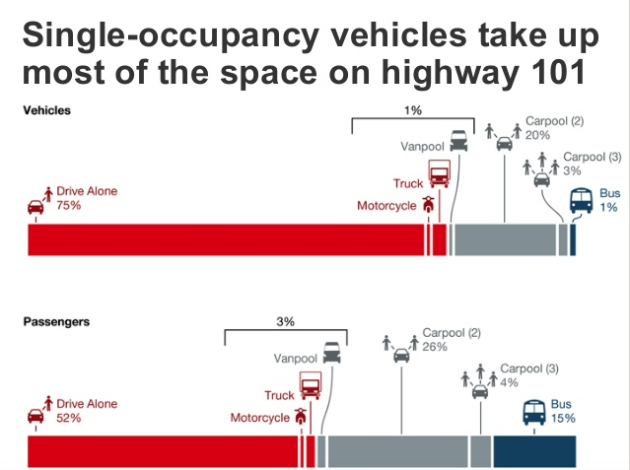
Fortunately, Caltrain electrification is moving forward, improving mobility on the Peninsula Corridor by rail. Â There are also opportunities to move more people on Highway 101, where cars with solo drivers take up 75% of the space but carry only half the people, according to SPUR’s analysis.
On Wednesday May 31 and Monday June 5, Caltrans is hosting two public meetings with updated information on studies of options to relieve 101 congestion, in partnership with the San Mateo County Transportation Authority and City/County Association of Governments.
Come learn about how the studies are going so far. Questions to ask include:
- is the study considering express lanes from San Francisco through Santa Clara County?
- is the study considering major investments in express buses and other nondrivealone options?
- is the study considering the impact of “induced demand†– when highway widening attracts more drivers?
- how would a toll-lane affect low-income commuters, and what is being planned to improve equity?
TransForm has material suggesting that FAST Express Lanes – converting a lane, and investing heavily in non-drivealone options and features to help low-income commuters – might generate results more rapidly and effectively.
Come learn how CalTrans study has gone so far, and what you can do to encourage outcomes that are the best for mobility, environmental sustainability and social equity. Â Â I hope to see you there! And please reply to this email if you can be there or would like more information.
Wednesday May 31st, 6:30 p.m.
San Mateo City Hall
330 West 20th Avenue
Monday June 5th, 6:30 p.m.
Redwood City City Hall
1071 Middlefield Road


All these extra or express lanes cost quite a bit of money. Why aren’t counties looking instead at using that money to fully fund public transportation (and help it be price competitive vs. private cars)?