How can the Peninsula corridor continue to grow when 101 is at a standstill? In a new study this winter, regional think tank SPUR presents a vision showing how to triple the number of people traveling the corridor in the same amount of space.
SPUR envisions improving all of the space-efficient ways to travel:
- For Caltrain, this means longer platforms and longer trains, and grade separations that facilitate more frequent service.
- For the 101 corridor, this means high-occupancy toll lanes, using revenue to support carpooling and public transit, including regional public express bus service, and equity policies to ensure the benefits are available to all
- Plus, ferries can add another 8% or so of capacity
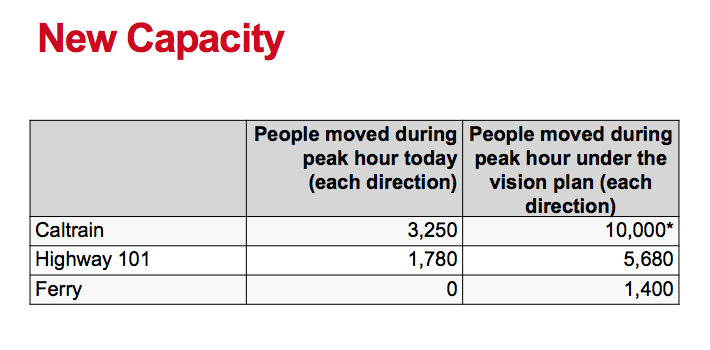
An important part of the solution will be enabling 101 to carry more passengers. Today, cars take up most of the space on highway 101 but only carry about half the people. Buses take up 1% of the space and 15% of the people.

To get achieve these outcomes, we’ll need better coordination and more funding
- Seamless connections for first and last mile – including regional connections to the East Bay via Dumbarton rail and BART Silicon Valley
- Pricing that helps people choose transit when they can – like integrated pricing for FastTrak, trains and express buses
- Coordinated investments to provide the bus and carpool services, with strong local programs to support less solo driving.
It’s up to us
SPUR envisions a broad mix of funding sources, much of which will be local and regional. In the near future, we can’t count on help from the federal government.  We’ll need to focus on regional and local funding and coordination to improve our commutes.

p.s. the presentation on SPUR’s website is hard to read, so here is a high-resolution, more readable version.


One of the things the WNAC has been looking at is the idea of high-speed corridors within the freeways to facilitate both public and private buses, similar to what San Diego does. The big difference is the creation of Transit-Oriented-Developments that would be strategically located at major intersections with the freeways. The public-private TODs would serve as a coupling point for the buses, along with last-mile solutions. More information can be found at this link:
https://winchesterurbanvillage.wordpress.com/2016/09/10/high-speed-vehicle-transit-on-existing-corridors/
and this link:
http://winchesternac.com/wp-content/uploads/2016/11/Freeway-within-a-Freeway-Flyer-left-column-10-26-16.pdf
Do you know how they got those Caltrain vs. 101 current conditions numbers? (Couldn’t find a methodology in the slideshow – seems super low for the 101, also from the ~ 2400/hour/lane that’s usually quoted for freeways – is it just public transit maybe?)
I can check
answer is “per lane”