On Friday, state assembly member Kevin Mullin filed a bill that would allow Caltrain’s board to authorize taxes to provide dedicate funding for Caltrain.   The bill is incomplete, since it doesn’t yet specify any particular sort of funding mechanism or specific objective.
What sort of funding might Caltrain be seeking? Â The basic problem mentioned in the draft bill text is that “Caltrain is the only transit system in the San Francisco Bay area without a permanent, dedicated source of funding. Other agencies rely on money from sales taxes, property taxes, state funding, and other sources.”
The bill could be used to provide stable funding for Caltrain’s annual budget. Â By California law, any new tax would also need to be approved by voters; the bill would allow Caltrain’s board to put a measure on the ballot rather than relying on the 3 county transit agency partners, or multiple cities, to all authorize ballot measures at the same time.
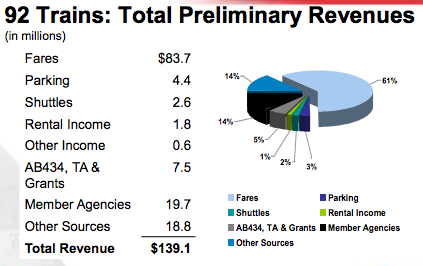
Caltrain gets about 60% of its operating revenue from riders, which is a strong performance for a US transit agency. The largest amount of public funding comes from 3 county transit agency partners who decide each budget year whether (yes, whether) to pay the bills to run the trains, and whether to pay the bills for basic maintenance, to keep the trains from breaking down. Â In the occasional event that one of the partners decides not to pay the bill, the partners have a “gentleman’s agreement” to reduce contributions accordingly. So Caltrain would need to cut service in case of reduction in operating budget, and would need to skimp on maintenance in case of reduction in “state of good repair” budget, resulting in more frequent train breakdowns. Both circumstances have happened.
The bill could also be a backstop in case any one of several things go wrong with electrification funding. Â Caltrain has gotten bids for rail cars and installation of electrification gear, and is currently negotiating with vendors. If bids come in high, Caltrain could conceivably need to cover a shortfall.
Also, Caltrain is expecting $113 million from High Speed Rail to pay its share of the electrification bill.   The High Speed Rail Authority’s access to Proposition 1A bond funds is currently held up in court. A hearing was held last week, with a judges ruling expected within 60 days.  Also, this Spring, High Speed Rail’s latest budget will be reviewed by the legislature, and the outcome will determine the availability of further state funding.
So the bill could conceivably be used to cover gaps in electrification funding, if it’s needed.
The bill would allow Caltrain to raise stable funding, or help address risks to the electrification budget. Â Information over the next several months will help determine what the bill will be used for.


The $113M is from the cap & trade funding for HSR. The lion’s share in the nine-party funding MOU from 2012 is $706M of Prop 1A bond funds, of which $106M is connectivity funding and $600M is HSR funding (the latter still subject to litigation)