Tonight, Mountain View City Council will consider final approval of its downtown Transit Center Master Plan (see next blog post), and will review interim results of a study of “automated guideway systems” connecting the Transit Center to North Bayshore where Google is.
If you are interested the transit center, or the long-debated question about how to add higher-capacity last-mile transit connections, come tonight.
Mountain View Transit Center – Final Decisions
The discussion on the transit center will recap for final direction many of the ideas that have been reviewed over time, including:
* closing Castro across the tracks
* adding a ramp for cars from Evelyn up to Shoreline
* adding bicycle/pedestrian undercrossings
* buildings on the parking lots
* a parking structure with more-than-replacement parking, to support downtown in addition to transit
* robust secure bike parking
* an expanded public plaza
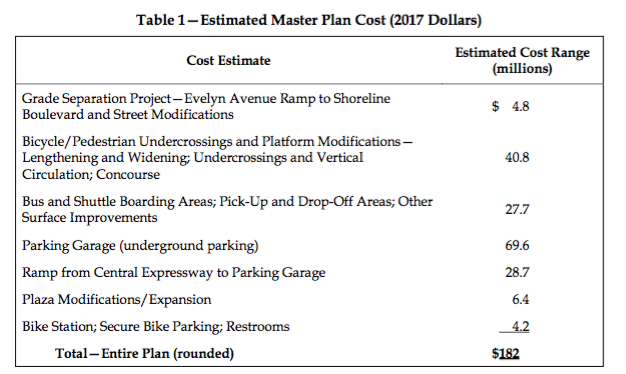
The grade separation elements that enable people driving, walking, and biking to avoid crossing the Caltrain tracks, add up to about $70 million, which is much less money than a full grade separation project.
The land use opportunities to extend Mountain View’s successful downtown, which residents and neighbors were excited about at a recent public meeting, will require follow-on exploration of joint development opportunities, including negotiating with Caltrain which owns the land.
North Bayshore transit connection
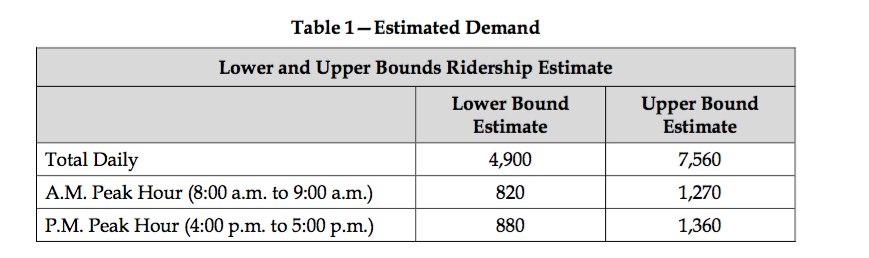
The preliminary North Bayshore connection first set out to answer the question of whether the technology options can handle the amount of expected transit use. The study estimates that the transit connection would need to support between ~5,000 and ~7,500 trips per day, and up to 1,400 trips at the most crowded afternoon peak hour. The largest use is expected to be Caltrain commuters coming to and from North Bayshore, with additional commute trips from North Bayshore residents, and noncommute trips for future residents of North Bayshore and “mainland mountain view.”
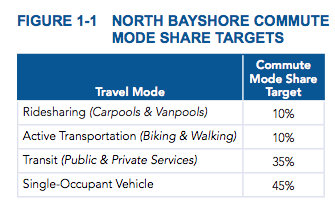
This is intended to support Mountain View’s plans to reduce drivealone mode share from 60% to 45%.  An important element of reducing solo driving is a goal to increase transit mode share from 25% (public and private) to 35%, while doubling the share of public transit from 20% to 40%.

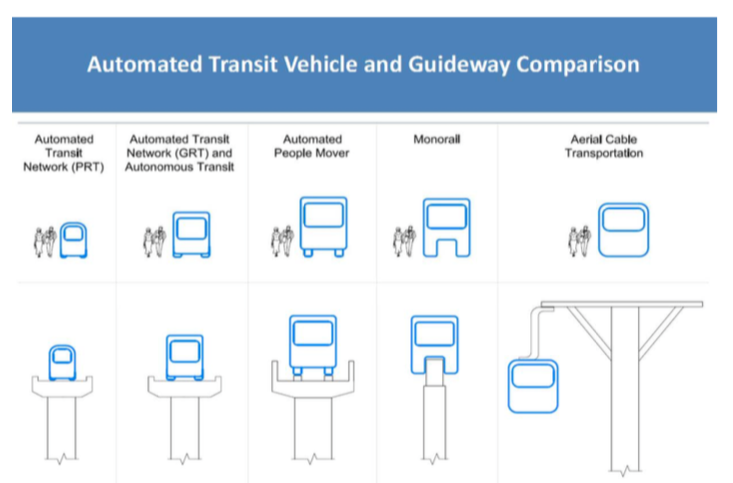
Currently, the shuttles connecting the transit center to North Bayshore take 15-20 minutes but get stuck in traffic. The next step is to create a dedicated lane for the shuttles on Shoreline. To get to the next level of capacity and reliability, Mountain View would like to add an “automated guideway transit” system – a term covering a variety of grade-separated technologies such as gondolas, peoplemovers, monorails, personal/group rapid transit, and a new contender, autonomous vehicles on a grade-separated right of way.
Interestingly, one of the options being considered is using new autonomous shuttles on a fixed guideway. Jacksonville, FL, one of the few cities that had an elevated monorail peoplemover (built in the 80s), is working on a plan to replace it with autonomous shuttles.
According to the research in the staff report, all of the choices they would considering could handle the peak volume. Â One question the study has not considered yet, however, is the ability of the technology options to handle a Caltrain train unloading. Â The 1400 passengers who might travel in a peak hour will be getting off of Caltrain trains, hundreds at a time. Â So systems that can board only a few people per vehicle might have a challenge with loading time, and several minutes would need to be added to the time estimate for boarding. (Update: looking at recent Caltrain ridership reports, Mountain View sees more popular trains boarding or unboarding up to 300 people at a time).
Looking at the need to pick up a trainload of people from Caltrain at once, raises a question  whether it makes any sense to consider more prosaic but fully mature light rail technology, branching over from the NASA/Bayshore light rail station.  A key question here is speed –  would the more circuitous route be time competitive? The travel time from the Transit Center to Lockheed Martin is already 12 min.
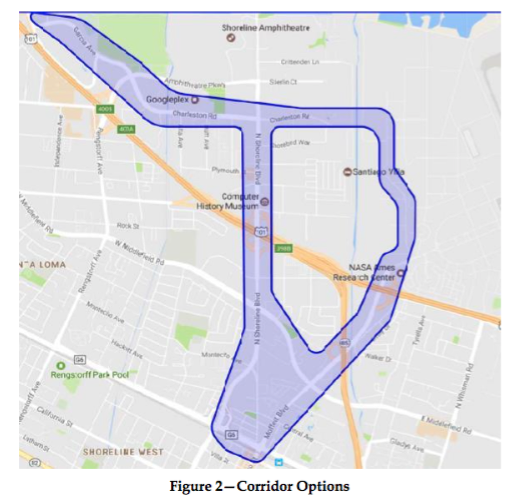
Another question that comes up in the city’s comparison of different options is how easy a system is to extend. Autonomous shuttles or podcar systems would be easier to extend; monorail/peoplemover and cable/gondola systems would be harder. Given the land use plan and plausible scenarios, how important is this need to extend? Given the planned land use, how many people would be working or living within a 5-10 minute walk of a system with routes on Shoreline, Moffett, and Charleston (see below) and are there plausible additional corridors and nodes to add to a system?

The meeting starts at 6:30pm, the Transit Center agenda item will start around 7pm, and there is one item in between the two transit-related items.
(As for the item in between, Mountain View is proposing to give a chunk of unused water allocation to East Palo Alto, where new development is frozen due to lack of allocated water supply).


[…] improvements, ranging from a dedicated bus lane on Shoreline which is moving forward, to an automated guideway system (think airport people mover) which is being studied, to potential new bridge and onramp connections […]