A new report from global expert Jarrett Walker (report starts on page 287) kicks off a two-year initiative to rethink VTA service with a goal of increasing transit ridership. The report’s findings contradict key tenets of conventional wisdom about transit in Silicon Valley politics, and may trigger lively discussions about how to improve transit service.
The dominant finding is that VTA ridership has declined because the agency is providing reduced service, despite a growing population. The study finds that service is most productive where it is most frequent, despite the higher cost, since frequent all-day service enables easy transfers and supports a variety of trip purposes. The report supports arguments made by TransForm and other advocates that ridership could be increased by providing greater service frequency on a core network.
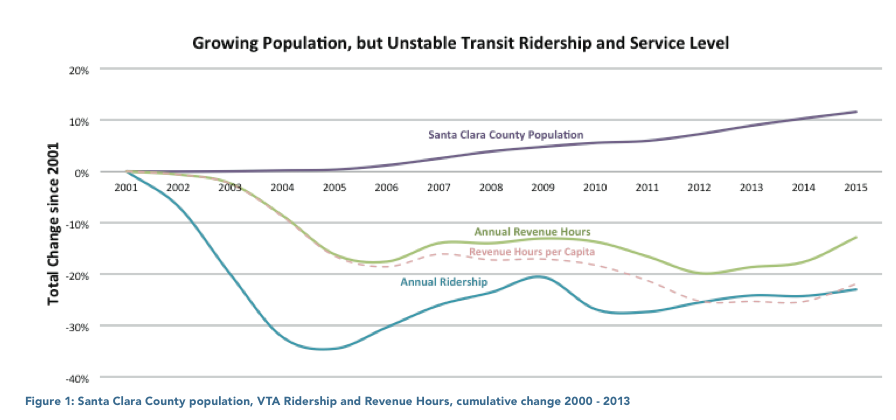
A key element of frequent service is the ability to make connections without long waits. Currently, the most robust transit service is found in East San Jose, with a grid of connecting service.  The report notes there may be other areas that could support high frequency grid services, especially those where urban-style nodes of density and walkability are emerging.  The report bolsters critiques that transit lags in West County because North/South routes are too infrequent.
Several of the report’s findings contradict conventional wisdom about Silicon Valley transit.
* Â Conventional wisdom: The main goal of transit should be alleviating rush hour congestion for drivers, and VTA would gain more ridership and financial stability with commute-focused service. Â Â In fact, according to the report, VTA’s most productive routes provide all-day frequent service for many kinds of trips, and ridership is steady throughout the day. Â Commute-focused service is harder to provide cost-effectively, since revenue trips are one-way, and drivers need to head back with empty buses. Â
*  Conventional wisdom: ridership is low in low-density suburban areas because of neglectful VTA service.  The report explains, by contrast, that high ridership transit depends on three factors: land use,  walkability, and service.   Areas that have low-density, single-purpose land use with poor walkability will not support high-ridership transit.   Land use and street design are under the control of local cities.
Hopefully this finding will catalyze lively conversation with city leaders who express concerns about poor VTA service, while maintaining low-density land use and streets that are not safe and attractive for walking. Â
* Conventional wisdom: VTA is unwisely neglecting major opportunities to relieve congestion on major freeway corridors, especially via commute service along Highway 85 and 237.  By contrast, the report’s analysis explains that transit is less cost-effective when it attempts to connect low-density housing and low-density job areas across long distances, with plentiful free parking at the destination.  This finding casts serious doubt on the goals of the West County coalition seeking large amounts of funding for long-distance commute service on the freeway corridors from low-density residential neighborhoods to spread-out office parks with free parking.Â
Express commute transit service is more competitive with driving when parking and/or road use isn’t free.  Are the leaders who want to fight congestion willing to require paid parking and/or roadway tolls?
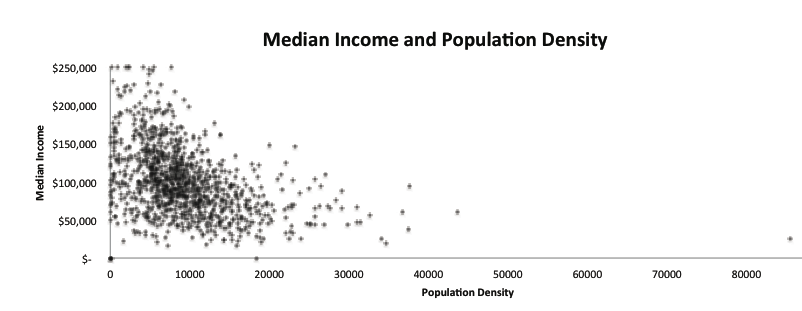
* [Conventional wisdom] transit is and should be mostly for low-income people who do not have other choices. The report shows that while transit is correlated to income, transit ridership is even more strongly correlated to land use density.  In Santa Clara County, less than 5% of commute trips are made by transit, and most low-income workers drive.  Since Santa Clara County’s growth over time will largely be infill development increasing density, it will be important to upgrade transit service to support the denser land use patterns. Â
Hopefully future phases of the report will look at opportunities, not only for transit to support planned land use, but infill land use opportunities that would support high-ridership transit. Â
Because high-quality transit supports economic opportunity, hopefully the discussion will also consider housing affordability in transit-rich areas.   With the increased popularity of denser, walkable areas, we are seeing a trend toward the “suburbanization of povertyâ€, with lower income people living in further-out, low density areas that are difficult to service with transit.
One of Walker’s key messages is that transit agencies need to make policy decisions about how to balance the goals of high-ridership, cost-effective service, and lifeline “coverage” services that are important to provide even if ridership is low. Â If VTA wants to substantially increase ridership without slashing lifeline service, revenue would need to increase.
The report also raises the issue of the transit fare structure in conflict with its ridership goals. VTA does not offer transfer discounts.  So an “out-and-back†bus/light rail trip with a transfer would cost $8.    Also, the frequent bus network is inadequate to connect East San Jose residents to a sufficiently wide range of opportunities such as jobs, school, retail, and other activity centers.  For longer-distance trips to economic and educational opportunities, it will be helpful to consider access to BART and Caltrain with bus connections and accessible fares.
Unfortunately, the study gives little consideration to the upcoming role of BART, and potential role of Caltrain, as part of a frequent network.  Caltrain and ACE are not considered “because they represent a small proportion of VTA’s budget.” This makes sense from the perspective of VTA as a financial entity, but little sense from the perspective of a transit user wanting to get to jobs, schools, and other destinations. Also, unlike VTA’s schedule choices, which are seen as variable and subject to policy change, Caltrain’s heavily peaked service is taken for granted. Electric service will enable more frequent all-day service to be provided cost-effectively – would this increase ridership, and how would it affect overall transit network performance?  The report also doesn’t take into account Stanford’s Marguerite, and other local service brands that are part of the network.
In summary, the challenges that lead to poorly performing transit derive from conventional wisdom about transportation and land use in Silicon Valley:
* we can have better transit while preferring  low-density land use and free parking
* transit should focus on alleviating peak hour congestion
* the main goal of transit is to serve poor people who are transit-dependent (although most low-income people in Silicon Valley drive)
* transit service improvements should focus on agency brands, rather than user experience
The report contains powerful insights that could trigger important debates and decisions that could help the region increase transit use, but we’d need to get past the conventional wisdom in order to achieve the goal.


Thanks for the writeup!
I’m not tracking on why you think our report “neglects” Caltrain and BART. The report is about VTA’s choices so of course it focuses on VTA service. The next report, presenting network alternatives, will have a strong focus on the new BART stations.
As for Caltrain, our shared emphasis on frequency captures why we don’t give it much focus. Frequency needs are proportional to trip length. Caltrain’s low frequencies make it useful for long multi-county trips but not very useful for shorter trips within Santa Clara County, and we don’t envision having control over that. (You may know that as president of an advocacy group 25 years ago, while I was at Stanford, I was obsessed with that issue.)
So the Caltrain connections are important, but without Caltrain frequency we would be unwise to build a frequent network around Caltrain. On the contrary, we’re noticing the need for better high frequency service between the Caltrain downtowns, and for now, with Caltrain so infrequent, that will have to be buses.
Thanks for an excellent study that hopefully will catalyze important discussions and good decisions about improving the transit network. From the perspective of VTA as an agency, the report focuses on what the agency can control most. But from the perspective of a transit user (or potential transit user) in Santa Clara County, the report arguably undercovers their current and potential transit service. It is true that VTA is only a partial stakeholder on Caltrain but VTA has a powerful role on the board. Caltrain electrification is scheduled to be implemented in the next five years, and could make it possible to increase service frequency. So may be more feasible now than 25 years ago to make a case for increased frequency – and it would be valuable to assess how that frequent service would affect overall transit ridership for people in Santa Clara County.
Thanks for summarizing – very interesting findings. Can you provide a link to the Walker & Associates report?
done
Here’s my review: http://blog.transitunlimited.org/2016/03/response-to-jarrett-walker-study-of-silicon-valley-transit/
“The other area where there could be more transit service is the area around the I-880 and I-280 interchange. That interchange is surrounded by Valley Fair Mall, Santana Row, Valley Medical Center, and San Jose City College. All of those locations are transit favorable and do have frequent service. However because of the street layout, none of these locations are interconnected… ”
“A shuttle service from Valley Fair to San Jose Diridon via Valley Med and City College and I-280 should be one of the ideas to be explored. Another is to break the route 25 (runs every 10 minutes east of Valley Med, and every 30 minutes west of Valley Med) and extend the terminal from Valley Med to Valley Fair. This would create connections within the core network with transfers taking place at an off-street transit center.”
Andy, excellent points about the Valley Fair & Fruitdale areas. The perfect route the light rail line should have taken would be to divert from SW Ex and go onto Fruitdale and then S Bascom, thereby serving City College and Valley Med. In light of that failure, we need improvements to the bus lines.
It seems logical (but expensive) for BART to eschew Santa Clara and instead follow the rail ROW to Parkmoor, then tunnel to a station at SJJC/VMC, then end at Valley Fair/Santana Row.
I disagree with your mention of a “shuttle service” or broken lines. The VTA keeps shortening so many of its lines, mainly those that are near light rail. Due to the crazy lack of free transfers and difficulty of making timely connections, we can’t suffer through more short shuttle lines.
Jarrett, to claim that Caltrain is not very useful for shorter trips within Santa Clara County is contrary to the current ridership, not to mention latent demand. Over the past few years, rides between SJ and Sunnyvale to MV and PA have grown astronomically; that in spite of fairly infrequent service, full parking lots, and sardine-packed trains. Intra-valley ridership could probably triple if the VTA would provide more leadership and funding for Caltrain to make more stops at all the SC County stations in the valley, with VTA buses making better connections. I’m not an expert in this, but since the VTA has chosen to spend monumental resources on BART and freeways, we should not accept as out of their “control” their kicking of Caltrain to the wayside.
Holy Heck, Jarrett is among the best minds in contemporary public transportation and this report is great! I shared with my North Sunnyvale neighbors on Nextdoor, which tends to be a hotbed of anti-development NIMBY-ism. 🙂
Excellent. For folk in Sunnyvale, the results would be a mix of findings that bolster what people have been saying, and things that would be counterintuitive or unwelcome to people who prefer mid-20th century suburban patterns. Walker agrees that Sunnyvale doesn’t get enough north/south route frequency (and thinks there might be opportunities to rationalize routes). The report says that for routes to have higher ridership there should be land use intensification along the corridors. But the report is pessimistic about the ideas of commuter express bus/light-rail on freeways without all-day service or supportive land use.
How did “conventional wisdom” become conventional wisdom? It’s *never* been true.
What Jarrett Walker’s study shows has been known since the *19th century* by those who study public transportation and design public transportation systems.
Can someone please explain what electrification has to do with frequency of service????
Electric trains have faster acceleration and lower operation costs, and I believe electrification project bundles signal upgrades. All of these factors allow a railroad to operate trains more frequently.