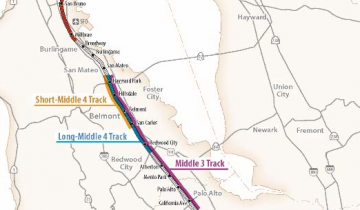
Tuesday, September 8th in San Francisco is the first of four meetings starting the planning for High Speed Rail on the Peninsula corridor from San Francisco through Gilroy.   All of the meetings will have the same program – an open house format starting at 4pm, with a presentation at 6pm.
San Francisco  – Tuesday, September 8, 4-7pm
Commonwealth Club, 555 Post Street, San Francisco
San Jose – Tuesday, September 15, 4-7pm
Roosevelt Community Center
901 E. Santa Clara Street, San Jose
Morgan Hill – Wednesday, September 23, 4pm-7pm
Morgan Hill Community and Cultural Center
17000 Monterey Rd., Morgan Hill
Burlingame – Wednesday, October 7, 4-7pm
Burlingame Auditorium, 850 Burlingame Avenue
If you’re interested and concerned about planning for High Speed rail service, and how HSR and Caltrain can work well together – these are important meetings to attend.
Unfortunately, there are no meetings yet scheduled for the Peninsula cities with the highest Caltrain ridership – Palo Alto, Mountain View, Redwood City, San Mateo. Â Ben Tripousis, Northern California representative for High Speed Rail, says that there will eventually be meetings in all 19 cities on the corridor.
Also unfortunately, the San Francisco and San Jose meetings aren’t close to Caltrain – both are about 30 minutes by bus or 15-20 minutes by bike from the train station.  The High Speed Rail project will have a major influence on Caltrain, including decisions regarding grade separations, station design, schedule, and commute capacity.  It would be better for HSR meetings to be more accessible to Caltrain users.



High Speed Rail planning starts Tuesday in SF for Peninsula corridor http://t.co/j3dWnYr86d http://t.co/qgeDBfHwaB
RT @bayrailalliance: High Speed Rail planning starts Tuesday in SF for Peninsula corridor http://t.co/j3dWnYr86d http://t.co/qgeDBfHwaB
RT @bayrailalliance: High Speed Rail planning starts Tuesday Sept 8 in SF for Peninsula corridor… http://t.co/6LFYFUYBUw
https://t.co/Wh0kJRFuPm High Speed Rail planning starts Tuesday Sept 8 in SF for Peninsula corridor… http://t.co/FeQurmLrch
https://t.co/Wh0kJRFuPm RT bayrailalliance: High Speed Rail planning starts Tuesday Sept 8 in SF for Peninsula c… http://t.co/FeQurmLrch
RT @bayrailalliance: High Speed Rail planning starts Tuesday in SF for Peninsula corridor http://t.co/j3dWnYr86d http://t.co/qgeDBfHwaB
https://t.co/Wh0kJRFuPm https://t.co/Wh0kJRFuPm High Speed Rail planning starts Tuesday Sept 8 in SF for Penins… http://t.co/FeQurmLrch
https://t.co/Wh0kJRFuPm https://t.co/Wh0kJRFuPm RT bayrailalliance: High Speed Rail planning starts Tuesday Sept… http://t.co/FeQurmLrch
http://www.mercurynews.com/news/ci_28750098/santa-clara-county:-cities-seek-regional-approach-to-transit-woes
***********************
I will do my best to be respectful here, but given that he is a Governmental representative, but to see this comment/quote at the end of the article, after all that is being done these days with BART/ACE/Caltrain/SamTrans/et al, is either slightly insulting to those of us that are doing everything we can for what he wants or something else. I’d like to say we can laugh at it but it wouldn’t feel right either. OF COURSE, the biggest issue that this screams is that THERE NEEDS TO BE A MEETING IN MOUNTAIN VIEW if stuff like this is being said!!!
[…] Peninsula High-Speed Rail Planning Open Houses Kick Off Today in SF (Green Caltrain) […]
RT @bayrailalliance: High Speed Rail planning starts Tuesday Sept 8 in SF for Peninsula corridor… http://t.co/6LFYFUYBUw
Meanwhile, here is an update on the “latest British fad”:
“The bi-mode units deliver the benefits of electrification now.”
“The dual-function of the units also means that we can keep passengers on trains during disruption, which we would not be able to do in fully-electric units.”
“Purchase of the electro-diesel trains because of ‘uncertainty’ around the government’s plans for electrification.” http://www.railwaygazette.com/news/passenger/single-view/view/hull-trains-to-order-hitachi-electro-diesel-trainsets.html
Stupid Brits…
@Roland, none of these applies to Caltrain. UK is buying trains before they can electrify the lines they want to run the trains on, Caltrain is buying trains as parts of the electrification project.
@William,
So we are going to advance the money for our trains to high speed rail and Ben Tripousis will give us a $600M IOU while they resolve a couple of “minor” legal issues? What could possibly go wrong???
With regards to “we can keep passengers on trains during disruption, which we would not be able to do in fully-electric units.â€, what is your solution? Walk to the nearest station, wait for a bus or ???
Did I forget to mention a complete line shutdown after a catenary failure?
@Roland, EMU and the Electrification RCS are more robust than you think. First of all, during system wide disruption on the electrified infrastructure, the signal systems would not function either, so any resemblance of normal operation would not exist regardless of the trains’ motive power. If sections of OCS were tore off during some accident or malfunction, trains could still do single-tracking or bus-bridges implemented. If the disruption was long term, I am sure there would be more important things to worry about than kept a passenger line running.
Caltrain’s future EMU trainset, as specified in the Caltrain RFP, has many redundancies: it would have two pantographs linked by a high-voltage link, so as long as one is functional the train would be able to operate normall; the trainset, like any other EMU, would have more than one traction motor so the train would not be stranded on one or a few motor failures.
Caltrain electrification RFP is already issued, and Caltrain has majority of funding available, so electrification construction would go on as Caltrain fill the shortfall.
Maybe not being able to get to 555 Post St. from Caltrain will draw attention to the fact that the DTX is bdaly needed.
@Henry,
DTX won’t get you to 555 Post but the Central Subway will.
Here is what you missed in case you could not make it in person: http://mv-voice.com/news/2015/09/09/high-speed-rail-shifts-focus-back-to-the-bay-area.
The Burlingame event is within walking distance of the station and is guaranteed to be a barn-burner.