Over the last couple of years, we’ve heard about employers including SurveyMonkey and RelateIQ that have started to  offer their employees credits for on-demand carpooling to get to Caltrain from neighborhoods in  San Francisco far from 4th and King, enabling them to take Caltrain to their jobs in Palo Alto rather than driving all the way.
To learn more about this trend, we interviewed Evan Goldin, product lead at Lyft, about the on-demand carpooling services they are offering, how they relate to existing transit services, and the potential to reduce drivealone mode share.
- Transit connections  Many people live in locations that are too far to walk from Caltrain or BART, don’t use bicycles, and don’t have practical options to get to the station by transit.   “First-mile†services are particularly useful for transit stations that have minimal or full parking, removing the risk that the commuter will drive to the station, find the lot full, and drive the rest of the way.
- On-demand carpool.  Lyft Line is an on-demand carpool service that provides a discount rate for multiple passengers who separately request a ride, enabling them to to share their ride if they’re headed in the same direction within a geographical zone.   Lyft sets up “hotspots†that are publicized pickup points, making the service like a micro-bus. Passengers get extra discounts for catching a Lyft at a hotspot, and the price for a ride starting at a hotspot is capped at $5. (Someone who requests a classic Lyft can use the ride themselves and with other parties in the same group, but not pick up additional passengers). This is is useful for relatively short commutes (for example, Palo Alto to Facebook), or for trips to popular destinations like a shopping mall.
- Commuter carpool. Lyft Driver Destination is a program where a driver going to a specific destination (like work), picks up passengers who are going to the same place (with classic Lyft, the driver goes where the passenger asks). Commuter carpool helps commuters make some extra cash, reduce their carbon footprint, and avoid parking charges in places that charge for parking. Â This service can be helpful, not only for work commutes, but any trip where there are people converging on the same destination, like, say, Redwood City on a weekend evening.
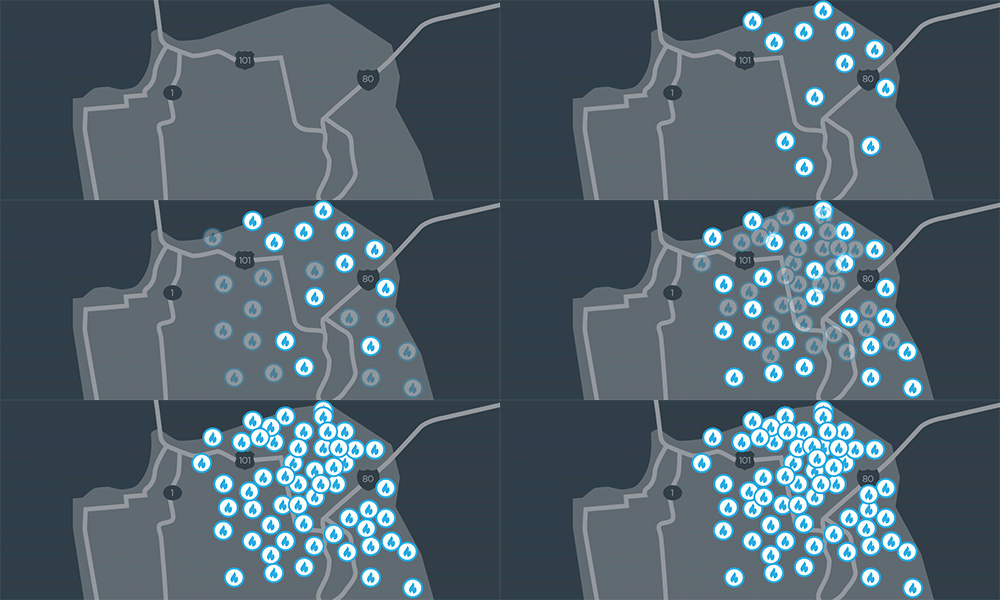
Lyft Line is currently available in San Francisco, Los Angeles, New York, and Austin, and is likely on its way to Palo Alto and other Caltrain corridor communities.
These services have the potential to make better use of existing backbone transit, to connect routes that are not serviced by transit at all, or providing more cost-effective service when transit with full-time drivers and larger vehicles is marginally cost-effective to run. Â Â Â These services also remove or reduce parking demand. Â In Palo Alto, for example, the cost of building a space in a new parking structure is $60,000-$70,000; the same amount of money can go a very long way toward providing alternatives to driving including public transit and on-demand carpooling.
These services have the potential to be financially supported by large employers, or, following a growing trend in the region, by a Transportation Management Association with a mission to reduce vehicle trips in a moderately dense area. Â Â As cities get serious about reducing vehicle trips in dense areas, these services can help achieve mode share goals and reduce traffic and parking burdens.


[…] Green Caltrain: “On-Demand Carpool” Services Can Reduce Parking Demand on Peninsula […]