At January’s Citizens’ Advisory Committee, Caltrain Director of Operations Michelle Bouchard walked through the decisions Caltrain faces in its effort to alleviate the capacity crunch prior to electrification scheduled for 2019. Â As of the board meeting earlier in January, the Caltrain Board has approved making an offer on a set of used railcars to add capacity. It will take another year to retrofit the cars.
Caltrain estimates that most crowded regular service trains carry 30-40% more passengers than they have seats.

The most crowded Caltrain trains
A big question for Caltrain is how to integrate the cars, how to make more schedule changes to fit more riders, and what other changes might help.
Caltrain’s new automated signalling system, being installed now, is expected help somewhat by allowing Caltrain to run trains closer together even before electrification – Michelle Bouchard said she would report to the CAC about how much improvement Caltrain is expecting.
The baby bullet schedule was very popular, with express trains helping Caltrain to double ridership over the last decade. Â But the schedule leaves gaps that suboptimize capacity. Should Caltrain tweak its schedule, or change it substantially to be able to carry more riders?
This post on service from Clem Tillier’s blog explores changes that Caltrain might make after electrification -what changes might make sense to make in the meantime.

Average trip length
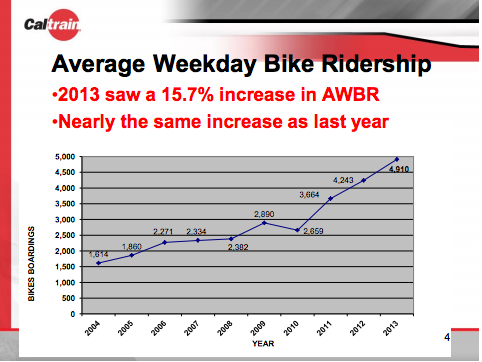
Another topic that took lots of time at the CAC meeting was discussion about whether to provide more bike capacity. Â Caltrain riders bringing bikes on board have increased even faster than the overall ~10% annual ridership increase, leading to continued “bumps” even after Caltrain added a second bicycle car on every train.
The San Francisco Bicycle Coalition’s Bikes OnBoard project is asking for a pilot to add a third bike car to avoid turning away passengers. Caltrain staff asserts that adding a third bicycle car would require an additional conductor on each train to avoid safety problems, which would incur high labor costs.
Riders with bicycles do take up more space than riders without bikes.  But the bicycles are also a cost-effective means for riders to make the “last mile connection.”  According to regional think tank SPUR, about 80% of the Bay Area’s jobs are within 3 miles of Caltrain or BART – which  means that many jobs are within an easy cycling distance although too far to walk.  Shuttles and bike share could help some riders – but these solutions aren’t free, and the location of Bay Area Bike Share kiosks don’t serve popular work centers in the Peninsula and South Bay yet.
Caltrain’s capacity challenges are one of the Citizens’ Advisory Committee’s top priorities for the year, so there are likely to be more meetings discussing these issues. Â If you have suggestions, you can send them to cacsecretary@caltrain.com in addition to adding them in comments below.


Caltrain wrestles with capacity crunch http://t.co/OxYhaTix2L
Could more bike share stations near Silicon Valley job centers help alleviate Caltrain’s capacity crunch? http://t.co/v64r3ZqyRz
Those Googlers should just take Caltrain – http://t.co/dNJot6JfkX
RT @murphstahoe: Those Googlers should just take Caltrain – http://t.co/dNJot6JfkX
This is what I use for my “last mile” connection:
http://www.razor.com/products/kick-scooters/a5-lux/
It folds up easily and fits under a caltrain seat, or on the overhead racks. I ride 4 miles a day, and go about the same speed as a slower biker. I wonder why I don’t see more of them on the Caltrain?
The current schedule creates some of these issues already. Crowding on the “bullets” could easily have something to do with their scheduling . Let’s blow up the current schedule and look at improving in a couple of areas:
1. Increasing seat inventory per hour by improving turn around times before adding more railcars to a train set.
2. Regular spacing of bullet trains with 3 or 4 per hour in peak time, with 2 or 3 per hour for others (i.e. 6 TPH peak total)
3. Use the Metrolink railcars to make more standing room and bike space available by the creation of additional bullet 5 car consists in line with point 1 and 2 above. And dispose of surplus gallery cars.
Only when the first 3 point have been addressed , should the notion of adding an additional railcar to existing train sets be considered. To do that first appears to be very lazy thinking.
It seems like a no brainer to add another pair of bullets at the end of each rush hour. One new northbound after #329 and a southbound after #376. Those are the most crowded north and south bound trains respectively and surely there are plenty riders of those trains who would prefer a later commute and workday.
Before buy additional rail car, I would like to see more improvement.
1: Reduce trun around time.
2: Change time table completely and redesign schedule to miximumize train utilizaiton.
3. Differentiate train length between local and express. 6-car for express/event only.
4. Increase frequency of local/Girloy train by reducing operating cost from shorter train. (And better accerelation)
5. Spend more money for rail car maintenance, as car mileage will be increased.
With improved schedule/frequency, Caltrain will see more rider. Then, Caltrain should buy Bombardia (2-door) Car.
@ztellman @casio_juarez @gfodor http://t.co/dNJot6JfkX
Will the cars be ADDED to existing 5-car consists, i.e. will we see some 6-car trains?
That is one of the main options that Caltrain is considering.
Thanks, Adina. That’s my favorite option. Caltrain management has been resistant to adding cars to existing consists, even on weekends when we know cars are available, explaining that the trains weren’t meant to have cars added (or reduced), yet to those of us who have suffered on “game days” the cheekby jowl accommodations, the reasoning is difficult to understand.
Caltrain had been reluctant to take on the additional operational complexity of maintaining train sets of different lengths, but they are overcoming this reluctance because of the capacity crunch.
RT @murphstahoe: @ztellman @casio_juarez @gfodor http://t.co/dNJot6JfkX
I would like to see more frequent train over longer train. Longer train provide more seat for existing customer but frequent train provide more seat both exisiting and new customer.
Regarding short distance trip, there are signifcant volume of passenger traffic between San Jose~Mountain View to Palo Alto. Most of Bullet are standing room only after Sunnyvale or Mountain View but many of those can find the seat at Palo Alto.
That Northbound AM crush between SJ and Palo Alto? I witness that every time now. Best I can figure, without conducting a survey, is that the vast majority of those disembarking at Palo Alto are GO-PASS holders. So now I’m wondering whether that program is inefficiently priced? Even if Caltrain did the math correctly, that would still point to a schedule/capacity problem in Silicon Valley.
Caltrain had been reluctant to market GoPass more aggressively because of the capacity crunch. Now that they are adding cars and looking for more ways to add capacity, that can create “headroom” for GoPass. If Caltrain loses money on GoPass compared to regular monthly fares, I suspect it would reasonable to increase the prices because it is still a great deal for employers.
I also saw 4PM Girloy local train became standing room after Palo Alto.
I suggest Caltrain to increase Go-Pass pricing in exchange with frequent services. Looking for fund of additional service from Go Pass program should make sense. This program fill the empty seat/space where used to be low ridership.
yes. GoPass is a great deal for employers – much cheaper than running private shuttles! I’ve done some napkin math suggesting that Caltrain could make substantial inroads in closing its operating funding gap by increasing GoPass prices modestly, and then marketing GoPass more assertively.
Caltrain did not change much of time table since 2005 but increased ridership. So, should we see more better farebox recovery rate?
Caltrain fills their seat from the San Francisco to Sunnyvale and from Palo Alto back to Milbrae. This is very efficent seat occupancy then any other commuter rail in US, even compared with BART.
VTA, (and Sam Trans, Muni?) sholuld pay more momey to Caltrain to fill the gap between Go Pass and regular Monthly pass. These money supposed to be go to Caltrain.
BART’s transbay tube runs 24 train/h but Caltrain runs only 5 trains/h.Why do they believe it’s in the capacity?
Majority of problem (time table and ridership) comes from speed difference between local and express trains and lack of overtaking capability.
I would like to see more train instead of longer train.
4-track section of Redwood City Junction and Milbrae platfrom 4s can be utilzed for local-express overtake.