One June 11, the Redwood City Transportation Advisory Committee reviewed options for Transportation Management Association services. Redwood City is resuming a policy initiative it had started before the pandemic with goals “to shift focus from automobile travel to embracing transportation in all forms—including walking, biking, and transit.
The study is exploring what services a Redwood City TMA should provide and prioritize, and what geographic areas it should serve.
While every jurisdiction is different, the well-documented experience of the Palo Alto TMA provides helpful lessons. The Palo Alto Transportation Management Association, which focuses on providing transportation benefits for low-income service workers, has fully recovered transit ridership among the low-income service workers it supports, helping over 250 commuters to reduce driving, reducing car traffic and parking demand. With this success, the Palo Alto TMA was recently awarded an increase in its funding from the city, including funds from parking revenue and general funds.
The Palo Alto TMA got its start serving low-income service workers downtown, and expanded its service area incrementally to support the California Avenue secondary downtown and El Camino Real and San Antonio transit corridors. Providing benefits for low-income service workers is a valuable niche since large employers such as Stanford already provide benefits.
Because providing these services is labor-intensive and requires building trust with service businesses, the incremental approach of starting with a focused service area and then expanding to a larger service area may also make sense for Redwood City.
Because most of the cities larger employers are in Seaport/Redwood Shores which are not near major transit hubs and have distinctive transportation needs, the ongoing survey will be very helpful in assessing whether there are services to provide to employers in Redwood Shores.
Also, given the growth of housing in the transit corridors, it may be helpful to provide services for housing developments (and over time, even neighborhoods) near transit hubs and corridors.
Interestingly staff report highlighted the longstanding travel patterns where commute trips represent a relatively small share of travel. This has always been the case, and the change in commute patterns following the pandemic highlights the importance of meeting a diversity of travel needs.
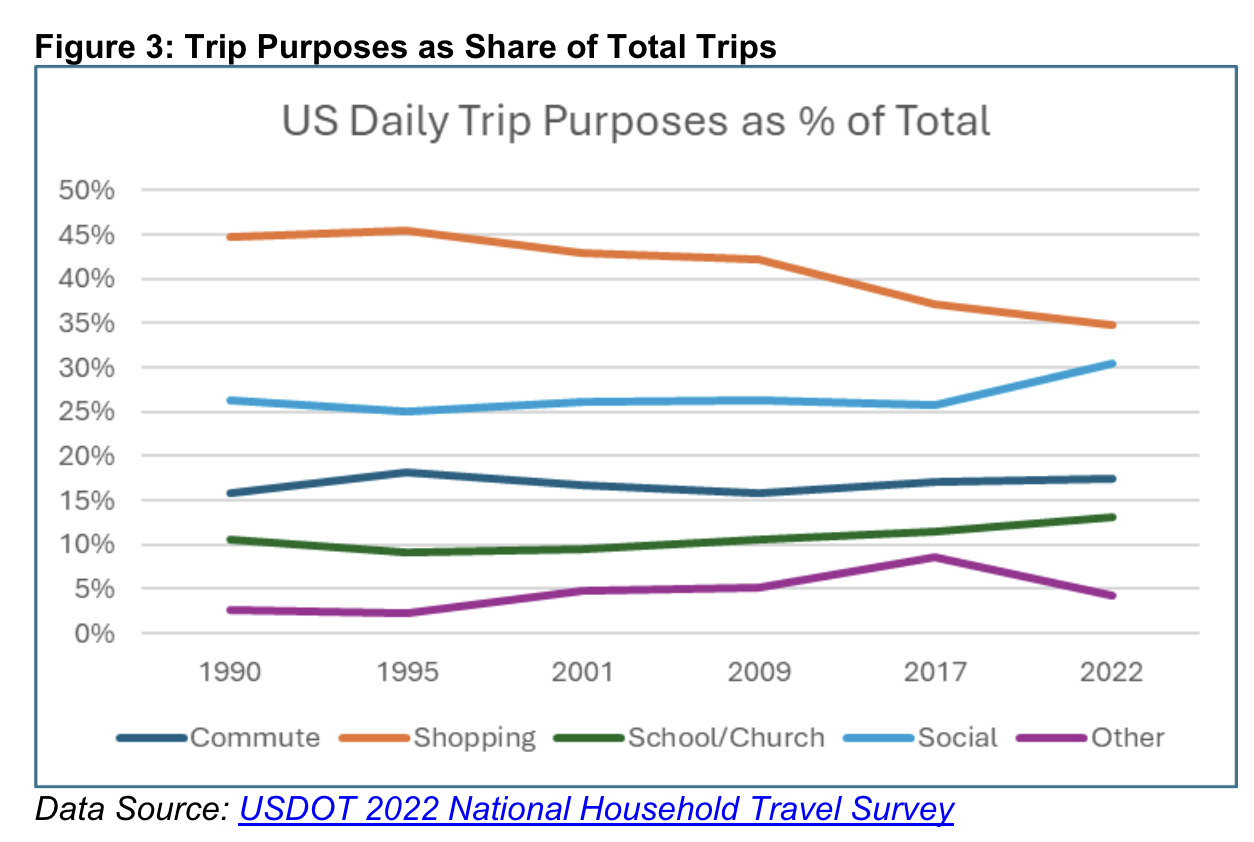
There may be opportunities for a TMA to help serve non-commute trips. Because this is a new service area, it may take more time and experimentation to figure out what sorts of services can help people travelling for entertainment, shopping, etc.
The City currently supports escooter services, and may also wish to explore microtransit services similar to Link in Palo Alto or Silicon Valley Hopper. However, this should be done cautiously, looking to the experience of similar services as to the cost/benefit.
One basic need is to maintain reliable data about the performance of the transportation demand management programs that recent developments were required to provide. According to the staff report, Commute.org is only tracking three out of 22 Redwood City Projects subject to TDM monitoring. Only two projects returned annual TDM reports for 2023. A TMA can help fill this gap in TDM administration, implementation, and monitoring, and relieve some burden from participating properties in managing TDM compliance.


