None of the scenarios that Brisbane council is starting to deliberate on tonight for the Baylands site, 600+ acres of formerly industrial land next to the underutilized Bayshore Caltrain station, consider the clear intentions from the California High Speed Rail Authority to build a train storage and maintenance yard on half the site. High Speed Rail has the legal right to take the property using the state’s power of eminent domain, paying a fair purchase price for the property.
If the High Speed Rail project continues to move forward and runs trains between San Jose and San Francisco, the options that Council members will be talking about are extremely unlikely to happen.
But – if City Council approves any of the project options is considering – the city and developer would stand to reap financial benefits because the value of the land would be higher with the approved zoning.
Starting tonight, the city council will be deliberating on whether to approve the project the developer is proposing – 7 million square feet of commercial space and 4,400 units of housing. Or an alternative with 1-2 million square feet commercial space and utility scale wind and solar farm, as a group of local residents has been advocating and the Planning Commission recommended.
The City Council could approve these options, or smaller versions of these options, or go back to the drawing board with a new environmental review process.
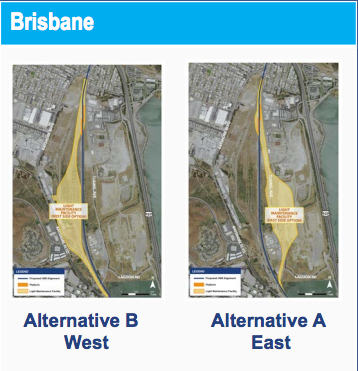
At the last City Council meeting, where High Speed Rail and a set of community groups made presentations, the High Speed Rail Authority’s plans to use half the Baylands site were clear and unambiguous. They presented options to use the East or West sides of the property, and in presentations to Brisbane City Council and other venues, have clearly explained why other options are not feasible. The intent to use half of the Brisbane site has been stated with increasing clarity over the last year in numerous community meetings.
During the public comment period, an attorney for the developer commented to Council that the High Speed Rail project faced a variety of risks, including the problematic climate for federal funding, the need to renew the state’s Cap and Trade program, and other project challenges. Therefore, the lawyer encouraged the City Council to approve the project as proposed, since the High Speed Rail service might never arrive.
It is true that the High Speed Rail project is a megaproject that faces many risks. At that meeting, the High Speed Rail Authority’s representative said that the environmental review of the segment between San Francisco and San Jose was being delayed.
But the developer and the city are not neutral parties if they bet that the High Speed Rail will go away before Baylands construction begins. They stand to benefit financially.
The Baylands decisions have attracted regional attention, given the regional housing crisis and transportation challenges. Organizations including SPUR and Greenbelt Alliance support a mixed use project with jobs and housing, because it is deeply problematic to add 20,000+ jobs without housing. The Bay Area’s deep housing shortage drives the highest housing prices in the country, and adding jobs without housing requires workers to commute long distances.
But none of the advocates – for mixed use projects with jobs and housing, or for a project that has commercial space and renewable energy generation – take into account the fact that High Speed Rail intends to use half the property.
Wouldn’t it be better for City Council to also consider options that assumed that High Speed Rail would use half the site, while the other half is used for a smaller amount of the proposed uses?
Disclosure: Friends of Caltrain presented at the community meeting, describing regional best practices to reduce solo vehicle trips associated with new development, including the increasingly common finding that housing near jobs reduces vehicle travel per person.


