Tonight, the City of Palo Alto will hear an update on plans to reduce car trips in the downtown area and Stanford Research Park (starting at 6:15), and later in the evening will discuss plans to pay for these programs and other transportation improvements (starting at 8:50pm). If you’re interested, come to Council tonight or watch online; and share your thoughts with city.council@cityofpaloalto.org
Here is some background on these exciting initiatives to tackle the traffic and parking challenges.
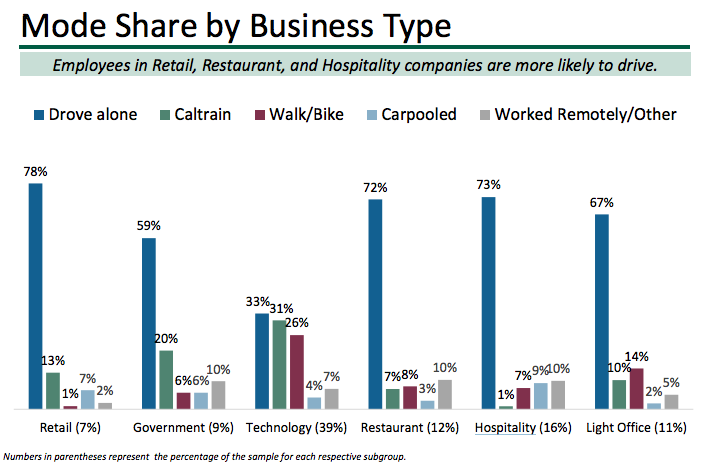
Two years ago, nobody knew how many employees worked downtown, how many drove, who drove, and what opportunities there might be to reduce traffic and parking demand. Â Now, solid research shows that 55% of downtown workers drive. But different types of workers have different drive alone rates – over 70% of retail/restaurant/hospitality drive alone while fewer than 40% of tech company workers drive. The research shows that half of current drivers would like a way to switch, and reveals the services that could help them switch, ranging from transit pass discounts, to help getting to the station, to help finding carpool partners. Â
Downtown businesses have created a “Transportation Management Association†nonprofit to manage programs to reduce driving.  The TMA is proposing to have some if its early programs focus on transit pass discounts low-income workers who say that price is a barrier to their use of transit; currently a low-income parking pass is $100 per year and the cheapest bus pass is more than $700 per year.  Over time, the TMA has an opportunity to work with Caltrain and other transit agencies to make GoPass and other deep-discount bulk purchase plans available to a consortium of smaller downtown businesses, improving affordable access to transit. Â
By contrast, Stanford Research Park has a much higher driving rate (likely ~80%), and plentiful free parking, which is a big incentive for workers to drive.  SRP has one major advantage  it is served by Stanford’s top-notch transportation team which reduced driving among university workers to less than 50%, and has large and prosperous companies with resources to reduce driving.
A key question for the evening will be how to pay for the trip reduction programs, particularly in the downtown with many small and low-margin businesses. Trip reduction programs can be funded with a variety of tools:
- Development fees
- Member fees
- Parking fees
- Business taxes
Given Palo Alto’s growth limits, development fees are likely to be a modest source.   Because downtown has many small businesses, and larger business already have low driving rates, membership fees are unlikely not be enough; so far the TMA has garnered about $50,000 in membership contributions and charitable donations.
Parking fees could be a powerful source of revenues.   Downtown parking is currently heavily subsidized – a full-price permit is $40-$50 per month (there are discount rates for low-income workers). If downtown full-price parking permits (currently 3,300 are sold) were priced the same as Caltrain parking ($5.50/day), it could raise over $3,000,000 per year to run programs to reduce driving.  Stanford reports that parking fees are the most important economic engine for their successful car trip reduction programs for university workers, and this is a critical source for programs in other downtowns with many small retail businesses such as Boulder.
Business taxes could also be a powerful source of revenues, could raise millions per year, and could provide a revenue base for bonds. Â In addition to TMA funding, business taxes could pay for local contributions to larger transportation investments such as local match for Caltrain grade separation/trenching, overhauls to transit stations, and long-distance shuttles.
Another important question is how fast to move on downtown trip reduction. Larger sources of revenue, such as parking fees and taxes, will take a while to be implemented. Â Should the downtown TMA start slowly until the revenue sources kick in, or should the city provide more startup funds, and reduce contributions as other sources are available?
To learn more, come to Council tonight or watch online; and share your thoughts with city.council@cityofpaloalto.org


