On July 12, a group of transit advocates, and managers of public and private shuttle programs made a pilgrimage to San Ramon to get a tour of the first driverless, autonomous shuttle program in the Bay Area, on a tour organized by Friends of Caltrain and Menlo Spark.  In addition to getting a ride on the nifty new devices, we learned much more about the pilot program, including the incremental testing steps and technology evolution that will be needed for this technology to transform first and last mile transit connections and fill gaps in today’s transit system.

Autonomous Shuttle from EasyMile pilot at Bishop Ranch
The tour was hosted by Chris Weeks, Director of Transportation for Sunset Development, the company that owns and runs Bishop Ranch, a corporate office park in Eastern Contra Costa County with over 30,000 employees working at 600 businesses across 10 million square feet of office. The development is growing to include residential developments, more retail and entertainment and civic space – San Ramon’s new city hall opened at Bishop Ranch in April.
Serving a low-density region, the Bishop Ranch transportation program is able to help 25-30% of workers avoid solo drive commutes, with services including transit pass discounts, last mile connections, private express buses, and carpool and vanpool support, and guaranteed rides home. Â

Bishop Ranch is piloting an autonomous shuttle, from French venture Easymile, to help solve challenges of last-mile connections and circulation around it’s spread-out campus.  Currently big commute buses need to take a long, circuitous route around the campus, which is inconvenient for people who work closer to the end of the route.

The first passenger-serving phase of the pilot will take employees of tenant companies from two of the ten building clusters to restaurants at lunch time. These routes will travel on public streets with cars and pedestrians, though the routes are relatively low-speed and don’t have signalized intersections.
The friendly-looking red vehicle travels a pre-programmed route.  The shuttles can run in “transit†mode – stopping at every stop – or in “bus†mode, stopping when requested by a passenger. They also have an “on-demand†setting that allows them to be hailed by a potential user from any location with an app being developed by BestMile. On the shuttle, a screen shows passengers where the shuttle is on its route.
The initial functionality of these fixed-route shuttles will be simpler than the “anywhere to anywhere†vision of autonomous cars, but the technical challenges are also simpler – it only needs to memorize a short, known route, not all of the streets in a metro. The number of things that can be unexpected or go wrong in a short route are much smaller than for an “anywhere, anytime†model. The initial mapping of a route includes mapping fixed structures along the route, such as permanent buildings, street furnishings, posts and curbs that can relied upon to verify the vehicle’s location.
A robot gets a license plate
To get to the passenger trial stage, the shuttles will need a couple of more months of testing, traveling a loop in a parking lot. A key goal of this initial testing phase is to look for any situations that might confuse the multiple sensors.
Once the tests are concluded, according to the terms of the pilot, the CA Department of Motor Vehicles and National Highway Traffic Safety Administration, working with an expert advisory panel currently being formed, would grant two license plates to operate carrying passengers on public roads, and the pilot would move forward. Â Chris Weeks, Â t , is confident that this step will move forward as expected, and planned for the pilot, though the brand-new process is still being fleshed out.
Next steps: traffic lights and transit connections
Like a teenager winning its parents trust in the family car, the EasyMile 10 needs to prove it can handle more complicated intersections with signals, merging, and turning. It basically has a learning permit with the next step proving that it can cross big arterial streets easily and safely. Â Â The challenge for the EasyMile 10 will be to handle a complex intersection with a stoplight, turn lanes, cross walks and lane merges. The vehicles have all the brains on board that they need to navigate these challenges at intersections, without adding functionality to the traffic signals, according to Weeks.
This milestone is essential to the next phase of the pilot, connecting to the San Ramon Transit Center on Camino Ramon, and to the new “City Center†and shopping areas in the Bishop Ranch area. The San Ramon Transit Center will be where the EasyMile shuttles will pick passengers up from Bishop Ranch Express Buses which bring commuters from regional BART and heavy rail transit. The small shuttles will then provide direct service to each building cluster, replacing today’s process where the big buses take long, circuitous routes.
After proving that the EasyMile10 can serve the transit center on the other side of Camino Ramon, the next major milestone will be connecting to the BART stations in Dublin/Pleasanton and Walnut Creek and the ACE train station in Pleasanton. For these 6-15 mile trips, Bishop Ranch would need a higher speed version of the vehicle which are on track to be available in the coming 5 years.

County vision for broad adoption
The pilot is supported by the Contra Costa Transportation Authority. If the pilot is successful, the county intends to deploy a fleet of several hundred driverless shuttles that would make connections within three miles of bus and rail transit stops (the use case is according to CCTA executive director Randy Iwasaki, and the size of the rollout is updated according to Chris Weeks).Â
Concierge mode and labor costs
In these first phases of adoption of a new technology, Bishop Ranch is running the shuttles in “concierge mode.† A human attendant is on the shuttle to put travelers at ease, and also to help passengers with mobility challenges. Â
The EasyMile shuttle doesn’t use a human driver. It doesn’t have a steering wheel or a brake. Inside there is a big red stop button, for use in an emergency, a button that can be used, as on a traditional bus, to flag a stop, and a button that can deploy a ramp for people with wheelchairs, luggage, strollers, etc (more about accessibility issues in a moment).Â
In the exceptional circumstances that the shuttle needs to go somewhere that’s not pre-programmed, such as going to the carwash area, a staff person can use a joystick-like control to steer and control the device.
In addition, there are cameras and sensors on board, which can recognize obstacles and problems outside and inside the vehicle. Â Â The camera feeds are visible to the dispatch center, which can take action if there are any major obstacles.
Operating in “concierge†mode saves some money compared to the cost of a human-driven bus, but the cost savings is obviously less running shuttles without human attendants. A shuttle attendant doesn’t require the same skill level as a trained, certified operator of a commercial bus.  For the shuttle service provider, the labor cost is about half the cost per service hour.  Â
Providers of bus/shuttle services already operate a “dispatch center†to monitor their buses and staff shifts, so that cost to operate a fleet remains in place.
Getting beyond “Version 1†technology
The vehicle we rode on the tour was one of the first two in regular operation in the US.   The shuttles hold a dozen passengers (6 seated), with an average speed of 12 mph and a top speed of 25 mph.  Powered by a lithium-ion battery, the shuttle can drive for 4-6 hours on a charge, and requires 8 hours to recharge.  The first model doesn’t yet have fast charging.
Logical improvements to the vehicle itself would include faster charging, more range, faster speeds, and versions with higher passenger capacity. Â The basic hardware for electric buses has matured in recent years – batteries are improving rapidly and it is reasonable to expect upcoming versions with more capable and standard hardware.
The price tag for the pioneering product is over $200,000 but the expensive components of an autonomous system, especially LIDAR laser scanning and sensing systems, are rapidly coming down in price as the components mature. For example, this article reports that Waymo/Google has gotten the price for LIDAR sensors down 90% over the last 12 months, from $75,000 to about $7,500.   The price of a diesel shuttle is in the tens of thousands, and an electric human-driven shuttle goes for ~$80,000 in today’s market [experts please correct if this is out of date], but with lower fuel and maintenance costs than a diesel vehicle, and lower lifetime cost of ownership.
Questions – ADA accessibility and Insurance
There are a few unanswered questions about how these devices would work in full-scale operation.
One important question in the US is accessibility to meet the requirements of the Americans with Disabilities Act. The first-version EasyMile shuttles don’t have fixtures to secure wheelchairs, and would need them for operators serving the general public.
Currently, fixed guideway services such as BART or airport people movers can serve passengers with wheelchairs without any human attendants. Buses in mixed traffic on open roads need “specific locations for securing the wheelchair to prevent it from sliding,†according to federal law.  Some bus services, including Seattle’s RapidRide express buses include a wheelchair restraint feature “that lets users roll into place without assistance from the bus driver†(see image).
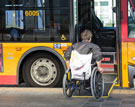
However, it is not clear whether an attendant to help if needed is an absolute requirement – the rules would need to be worked out to determine whether shuttles and buses can be operated without a human attendant in a way that complies with ADA.
Another important issue is insurance. Autonomous vehicles are expected over time to be safer than human drivers, even trained and licensed professional bus drivers. But the legal system still needs to be able to assess liability in case something goes catastrophically wrong.
One service provider operating EasyMile based pilots in Australia offers insurance as part of the package. Â We would expect to see this sort of offering becoming a requirement for mainstream commercial operation. Â
Filling gaps in the transit system – Â costs and adoption
As you can see, and a number of milestones need to be reached for the technology to be ready for mainstream adoption.
Transportation service providers, such as managers of transportation demand management programs and city shuttles are eagerly watching the testing of this new technology to assess whether and when they will help service providers deliver service that wouldn’t be feasible with human-operated buses.  The largest cost in the operating budget of a public or private transit provider is human labor.
Especially in less dense areas, there are types of routes that might be attractive to people, but can’t be provided cost-effectively with human drivers.  First and last mile connections and neighborhood routes with lower ridership are often not provided or at risk of being cut back because the economics are difficult.
The capital cost of autonomous shuttle hardware in its early days is likely to be supplemented with grant funding that supports electric vehicles and transportation innovation, but prices will need to come down rapidly in order to be competitive – and are likely to do so.
Service providers will need to assess which routes would be cost-effective if run with a moderate-skilled concierge vs. a fully-trained bus operator, and which routes might become cost-effective when these devices can be run without an operator.
This chart from King County Metro, a major Seattle area bus operator, shows that wages and benefits account for 70% of the agency’s operating costs.

King County Metro operating costs
A concierge, with a similar skill level as customer service worker in hospitality, would make about half the amount of a trained bus driver. Â Logically, this would result in about a third cost reduction in the operating cost of the service, using King County Metro as a prototype.
Even with a concierge, and without full driverless operation, this level of cost savings might enable new routes or improved service hours that are not cost-effective today.
For example, the San Mateo County Transportation Authority monitors the price/performance of commute and community shuttles that are paid for with public funding, with a benchmark cost of $7.00 per ride for commute shuttles that connect transit centers to offices, and $9.00 per ride for community shuttles that take people around the community to a range of local destinations (some shuttles take commuters at peak period and run community service at other times).

Some shuttles struggle to reach these cost metrics. Even operating with a concierge, an autonomous shuttle might make some additional routes feasible, and allow more frequent service for existing routes. Â Â
Fully autonomous operation would provide a significant additional reduction in costs, allowing service that is difficult to cost-justify today.
For creative and forward-looking planners and policymakers in places with lively downtowns, parking is another part of the cost/benefit equation. Â Â Cities including Mountain View and Boulder, Colorado are piloting subsidies for Lyft/Uber to help visitors get to downtowns without needing parking. Â Â Along these lines, and additionally there may be some neighborhood shuttle routes that could help cities reduce the cost of hugely expensive parking garages, which cost $50,000 or more in capital cost per space, and take valuable real estate away from housing and commerce.
Autonomous shuttle services might gain traction earlier among private providers like Bishop Ranch, and nonprofit Transportation Management Associations. Such services are likely to see opposition from unions representing public transit agencies. Â Â Crafting service offerings that add new routes with autonomous technology might be a good strategy.
The technology is further from mainstream adoption for high-volume routes. For example, Stanford Marguerite shuttle system moves over 6,000 commuters each day, with ridership concentrated at peak periods. Â To meet these demands, Stanford needs large buses that can travel at full speed. Â And to make the savings worthwhile, they would need the system to operate fully autonomously. Â Â
As we saw on the tour, autonomous shuttle technology is now a reality but is in an early stage with the regulatory system in the US., There are important milestones ahead to prove performance to the regulators, and lower hardware cost to enable broad adoption. Other parts of the world are ahead of us in the United States, with an array of use cases operational in Europe, and Asia.
This technology has potential to fill in key gaps in the transit system, and help reduce valuable space used for parking. It’s exciting to watch this innovation evolve.


