New analysis from Caltrain shows that its proposed Go Pass fare hike is headed in the right direction and arguably could go a bit higher. Â But the likely impact of increases to individual fares, such as monthly passes and Clipper cash won’t be known until the end of the year.
Go Pass increase in the right direction
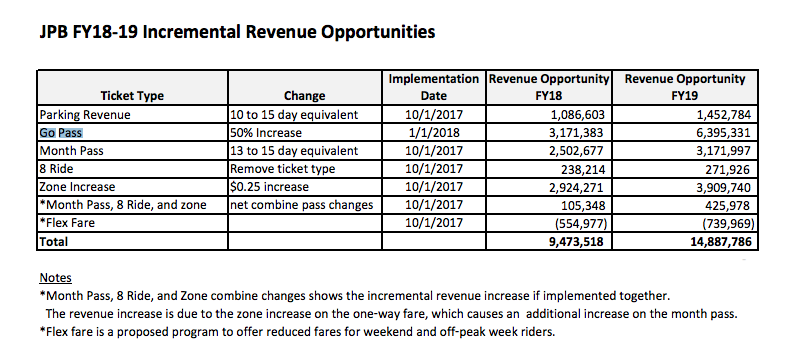
The current Go Pass is deeply discounted. Â Caltrain’s revenue per passenger mile for a Go Pass passenger is $.13, which is 46% less than the price of a typical monthly pass. Â So it would seem that increasing the price by 50% would bring it in line with the employer’s other logical choice, which is to buy monthly passes for commuters.
But, Caltrain’s analysis also shows that the Go Pass costs on average $2.90 per passenger. This compares to $4.70 per passenger for a monthly pass, or a 62% discount.  (This is because GoPass trips are on average somewhat shorter, 21 miles instead of 25 miles.) So, perhaps Caltrain could increase the GoPass a bit more, by 60%, raising an additional $500K per year, while remaining competitive with employer purchase of monthly passes.
The key question is how employers would respond to the change – at what price level would employers shift to monthly passes, which would have the likely effect of somewhat depressing transit ridership and increasing traffic and parking demand, since handing out GoPasses to all employees tends to increase transit use.
Another question is whether it is financially feasible for Caltrain to phase in the Go Pass increase over two years, the way that VTA is phasing in Eco Pass increase, to help employers adapt their budgets.
Once Go Passes are fully priced, this would be more incentive for Caltrain to allow Transportation Management Associations such as the Palo Alto TMA, and major employers such as LinkedIn to administer the Go Pass program for large groups of workers at their location.  Major employers host large numbers of contract service workers who under current terms are not allowed to be included in the employer’s GoPass. And downtowns have many small businesses that are too small by themselves to purchase a GoPass but a TMA could provide central administration.  VTA already allows for this type of administration at San Jose airport, where the airport’s Eco Pass covers airport workers as well as employees of restaurants and contractors.  If full-site GoPasses were common, this could potentially bring in substantial revenue to Caltrain.
The way the GoPass program works, large employers pay $190 per employee for a full year (compared to a similar price for a regular pass per month), but the employer needs to pay this price for all of their employees. The effective discount is much less than the list price, but still, as it turns out, quite deep.
Risk of individual fare increase unknown
While Caltrain’s analysis provides valuable information about the level to adjust the GoPass, the impact of raising individual fares is unknown – and potentially risky.
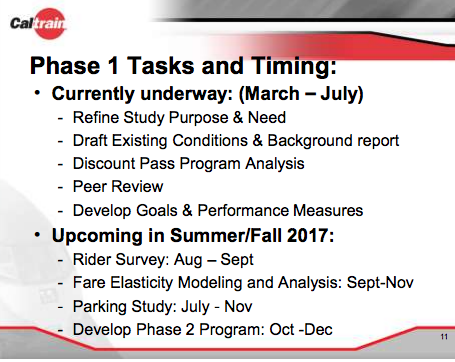
Caltrain is conducting a “fare elasticity study” through November to assess the tolerance of individual customers (for example, purchasing Clipper cash or monthly passes) for fare increases. Â While the average Caltrain rider income is $129,000, more detailed analysis shows that 25% of Caltrain’s customers come from households considered “very low income” by Bay Area standards considering cost of living.
Also, Caltrain’s demographic analysis has not published the income breakdown by fare category. Â Are GoPass holders disproportionately represented among higher income categories, and individual purchasers over-represented in lower categories? If so, the risk of increasing individual fares might be higher.
Looking to the future, for Caltrain’s business planning, it would also be helpful to understand the price tolerance of Caltrain non-riders. Â What would be the affect on ridership if individual fares were lower? If more people used Caltrain, what would be the benefit for traffic congestion, parking demand, pollution, and transit-oriented development. Â These are important questions to consider looking forward to electrified service.
Can Caltrain defer individual fare increases til risks are understood?
Caltrain’s revised operating budget shows $2.8 million in lower costs. We’re calculating that Caltrain would need $5 million from fare increases to balance the budget without violating the new proposed reserve policy. Â (corrections are welcome if needed)
Does this give Caltrain the leeway to defer individual fare increases until they have a better assessment about whether the prices increases will backfire by decreasing ridership?