On September 28, a panel of experts talked about the options to address congestion on 101, in the context of trends and policies in the region and state.  The presentations discussed critical questions about how to improve transportation in the corridor to get the best results for commuters, the environment, equity, and taxpayer budgets.
Kate White of CalSTA, the state transportation department, presented on a new generation of state policies affecting highways. The state is turning away from seeking to address congestion through freeway expansion, since this strategy has been shown not to be effective at relieving congestion; drivers flock to newly expanded freeways and congestion rapidly returns. Her handout for the event is titled “Increasing Highway Capacity Unlikely to Relieve Traffic Congestion.â€
White explained that based the state’s ambitious new climate law, SB32, California is required to reduce its greenhouse gas emissions to 40 percent below 1990 levels by 2030. To do this, California will need to do much more to reduce greenhouse gas emissions in transportation. Meanwhile, new rules for the California Environmental Quality Act will encourage transportation and development projects to reduce vehicle miles travelled, steering toward different approaches than highway widening which tends to increase vehicle miles travelled. However, state and federal funding for highway projects has been declining, and county funding is playing a greater role, so the state may have less power to affect local decisions.
In the question and answer period, White explained that converting a general-purpose lane to a toll lane is not currently allowed under state law, but that there had been some interest in potentially modifying the law.
Randy Rentschler of the Metropolitan Transportation Commission talked about the transportation challenges posed by rapid growth. Caltrain trains have become increasingly crowded. SamTrans had cut its express buses service, which used to carry thousands of commuters, back when BART was extended to Millbrae, with the goal of avoiding competition, but now we need more transit capacity.
Rentschler explained a strategy to increase the number of commuters using the highway, with “managed lanes†that carry carpoolers, buses, and might charge a toll allowing those who pay to use the toll lane. Given the volume of traffic on 101, Rentschler noted that 2-person carpools wouldn’t help congestion at all – we would need to see more people using 3+ carpools, vanpools, and buses. Technology can be used to control whether solo drivers can use the toll lane; if the lane is full, it can be reserved for higher occupancy vehicles.
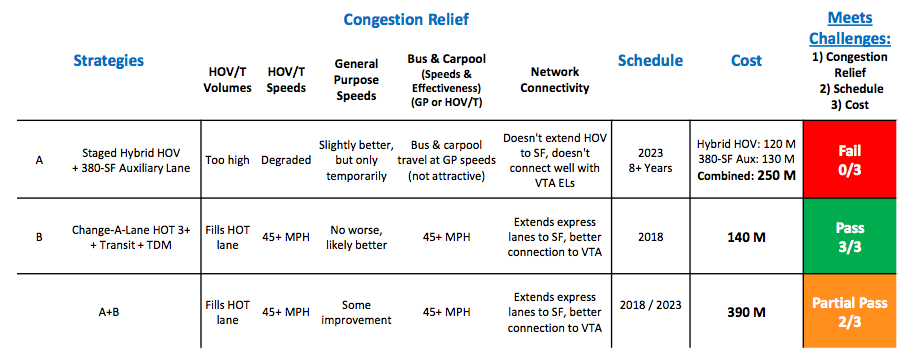
A study last year  from MTC, which replicated the results of an earlier study by TransForm indicated that an HOV3+ Toll lane, using funding for increased transit and transportation demand management, would provide the best congestion relief at the lowest cost, and that lane conversion, would be the least costly and fastest way to get those results.
But can toll lanes be fair for lower-income people? Chris Lepe of TransForm provided a case study from LA Metro, which converted existing carpool lanes into express lanes on two highways and used the revenues generated by the tolls to upgrade its bus service along those corridors, leading to major gains in transit use along these corridors. For low-income motorists, the agency offers pay-as-you-go memberships, cash payment options, and free registration and equipment fees for drivers who qualify. So, program design can mitigate the potential equity consequences. TransForm wants to see the 101 study include an equity analysis to assess ways to reduce impacts and provide benefits for lower income commuters.
If 101 were reconfigured to carry more passengers in carpools, vans, and buses, will people actually use these options?
Brian Shaw, who heads Stanford parking and transportation, talked about the university’s powerful transportation demand management program, which reduced the share of people driving alone from over 70% to 50% or below. The motivation for Stanford wasn’t just altruism – Santa Clara County imposed a trip cap where Stanford could only add buildings and employees if they didn’t add any more car trips. To adhere to the trip cap, Stanford charges for parking, regularly increases parking fees, and uses the fees from parking to run their robust “Marguerite†campus and last-mile shuttle program, while providing transit pass discounts and other commute benefits making these options competitive to driving in cost and convenience.
Shaw emphasized that fully subsidizing parking makes it very difficult for alternatives to compete, and charging for parking is an essential tool to make alternatives financially attractive to commuters. Shaw noted that one the biggest issues fostering long commutes is lack of housing near work that is affordable even to Stanford’s professional employees. As a provider of Stanford’s popular Marguerite shuttle services, Shaw also discussed the cost and operational challenges of running long-distance express buses. Peak hour, one-direction services are costly to run, since the buses and drivers are idle in the middle of the day, and need to run empty or nearly empty in the nonpeak direction.
Chris Lepe of TransForm emphasized about how our region’s land use patterns, where housing is far from jobs, makes congestion much more difficult to address. The escalating cost of housing poses the greatest burden on lower-income workers who face increasingly long commutes.
Andrew Heidel of the San Francisco County Transportation Authority (SFCTA) talked about related efforts to improve commutes on 101 in San Francisco, and the importance of regional cooperation to achieve the best results for commuters.
Lastly, I summarized briefly the mix of solutions that the San Mateo City/County Association of Governments (C/CAG) and CalTrans are analyzing. The options are a combination of two sets of choices: adding a new lane or converting an existing lane to high occupancy; having a high-occupancy lanes requiring carpools with a minimum of 2 or 3 occupants, and offering a toll option allowing solo drivers access to the faster lane for a fee. Meanwhile, SamTrans is conducting a study about potentially bringing back 101 express buses.
Thumbnail summary:
- Evidence shows widening highways is unlikely to fix congestion, and is likely to increase driving, vehicle miles travelled, and GHG emissions
- California has new policies requiring steeper reductions in GHG emissions and encouraging reduction in VMT
- The region has a strategy to increase throughput on highways by managing lanes to encourage more people per vehicle
- High occupancy toll lanes can alleviate congestion and raise money for transit options, but raise equity concerns
- Earlier studies suggest that converting a lane, and using it for HOT3+ would have the best congestion results for the least money in the least time
- There are strategies to reduce equity concerns which can be studied
Transportation demand management programs, supported by local policies regarding trip caps and parking, can increase use of carpools and transit - SamTrans is studying bringing back public express buses, which could add needed transit capacity, but can be financially challenging to run
- Land use – lack of housing near jobs – is one of the underlying causes of long commutes
- Partnership with San Francisco has the opportunity to provide better solutions for commuters
- San Mateo County is studying a variety of options; attention and participation will be valuable to help achieve options to move more commuters with less climate pollution
There are important decisions to be made in the next few years which will benefit from public participation
Presentation Materials
http://www.slideshare.net/alevin/kate-white-101-solutions10122015ncst-briefinducedtravel
http://www.slideshare.net/alevin/randy-renschler-mtc-san-mateo-101-solutions091515-v3
http://www.slideshare.net/alevin/brian-shawstanford-101-solutions09282016
http://www.slideshare.net/alevin/smcta-101-corridor-managed-lanes-092816
There are two upcoming milestones relating to the 101 managed lanes project.
1) The environmental review process is starting in October, with a public scoping meeting on Thursday, October 27, 6pm-8pm, at San Mateo City Hall, 330 West 20th Avenue, San Mateo.
2) The County’s transportation policies, and funding for this and other projects, will be shaped by the San Mateo County County Transportation Plan 2040.  Comments are being taken until October 31, with a survey here that can be used to provide feedback.
In order to pursue 101 solutions that will improve commutes for the most people, with the best environmental results and equitable access, it will be important to have participation from community members.


How about for starters, we convert the left lane to just a carpool lane.
We can add hot tolling later when law allows it.
[…] Mateo.  Come if you can, or submit comments by the deadline of Friday, November 18. Here is a writeup of the recent 101 Solutions Forum with some suggestions for […]
It boggles the mind that San Mateo (for the most part) and San Francisco counties have no carpool lanes on 101. There’s absolutely no incentive to carpool! Why bother picking others up and taking the cars off the road if you’re not going to save time? The counties to need to fix this ASAP and give people some incentive to rideshare or take transit/shuttles.