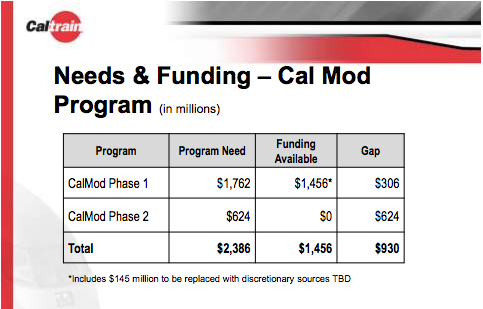
At last Thursday’s Caltrain board meeting, in an update on a Short Range Transit Plan Draft required for the Metropolitan Transportation Commission, Caltrain revealed the nature and price tag of a Phase 2 of the Caltrain electrification project.
Electrification Phase 1 that will provide cleaner, faster, more frequent service in 2020/2021, by giving the trains electric power (but only 75% of the diesel trains are planned to be replaced on day 1, because there isn’t money to replace them all)
The proposed Electrification Phase 2 project would provide about twice the peak hour capacity compared to today’s system, by
*Â Â expanding the platforms to take longer trains that carry more riders
* upgrade platforms to allow level boarding, which provides 50% speed improvement over and above basic electrification
* replace the remaining diesel trains with electric, enabling cleaner, faster service, and transition to level boarding
Caltrain estimates the price tag for Phase 2 to be $624 million, over and above a cap of $306 million in cost increases for Phase 2 since Caltrain updated it’s 2008 estimates.
This information will be important for the regional decisions about what to cover in 2016 ballot measures. The Phase 2 project proposal does not include any funding for grade separations to improve safety and reliability. Â San Mateo County has funding set aside for grade separations due to previous county transportation revenue measures, but Santa Clara County does not.


[…] Caltrain Upgrades Over Budget (GC); South SF Approves $49M Station Rebuild (Daily […]
Attachment (Updated Short Range Transit Plan Draft) indicated that midday freqnecy is 30 min and there is no change in weekend frequency.
Even Caltrain receive same level of subsiduary, significant operating cost reduction after electirfication makes Caltrain to provide more frequent service.
Caltrian is also considering 3-car EMU option. If this shorter consist runs one conductor, they can double the frequency for midday, late night and weekend.
Agree with Evans. Many people will continue to avoid Caltrain if they know that the frequency is so low.
And yes, eliminating one of the TWO “conductors” on every train would be a great way to save money and show the public they’re serious about not being wasteful.
We also need to pressure Palo Alto, specifically, to grade-separate all street crossings. Their collisions cause more delays to thousands of riders than any other city’s.
Here’s a wild and crazy idea: get rid of both conductors and rely on random POP ticket inspections instead.
The Brits clearly have phase 1 and phase 2 backwards: https://www.youtube.com/watch?v=6PdTr06tIlA.
Result: 112 miles in 1 hour and 23 minutes on http://www.virgintrains.co.uk/ all paid for and executed by the private (can you spell Google?) sector BEFORE electrification: http://en.wikipedia.org/wiki/Chiltern_Main_Line#Electrification
Did I forget to mention that they were on time (20 months) and on budget ($1B) and that they will electrify for 1/4 the cost of SamTrans in 1/2 the time AFTER upgrading the line to 125 MPH?
From the presentation, Caltrain will purchase 96 EMUs for the first phase. This will be 16 sets of 6 car consist or 32 sets of 3-car consist.
Having some 3-car consist should be better because of capacity adjustment while maintain high level of frequency in midday, night, and weekend.
I would like to see 15 min frequency for both local and express train. Here is example.
1) 6-car Express SF-Tamien but local south of RWC (70min one way) .
2) 3-car Local SF-RWC only (45 min one way)
Round trip of express will be 150min, so 10 sets of 6-car are required. Local needs 8 sets 3-car consist. In the peak hours, 14 out of 16 trainset are put into services. This number looks very small spare ratio given US commuter rail industry. However, EMU have much better reliabiluty than diesel operation and all the EMU are new fleeet.